
Is finishing our trails a possible dream?
Reviving Kent Harfst’s vision for Webster City
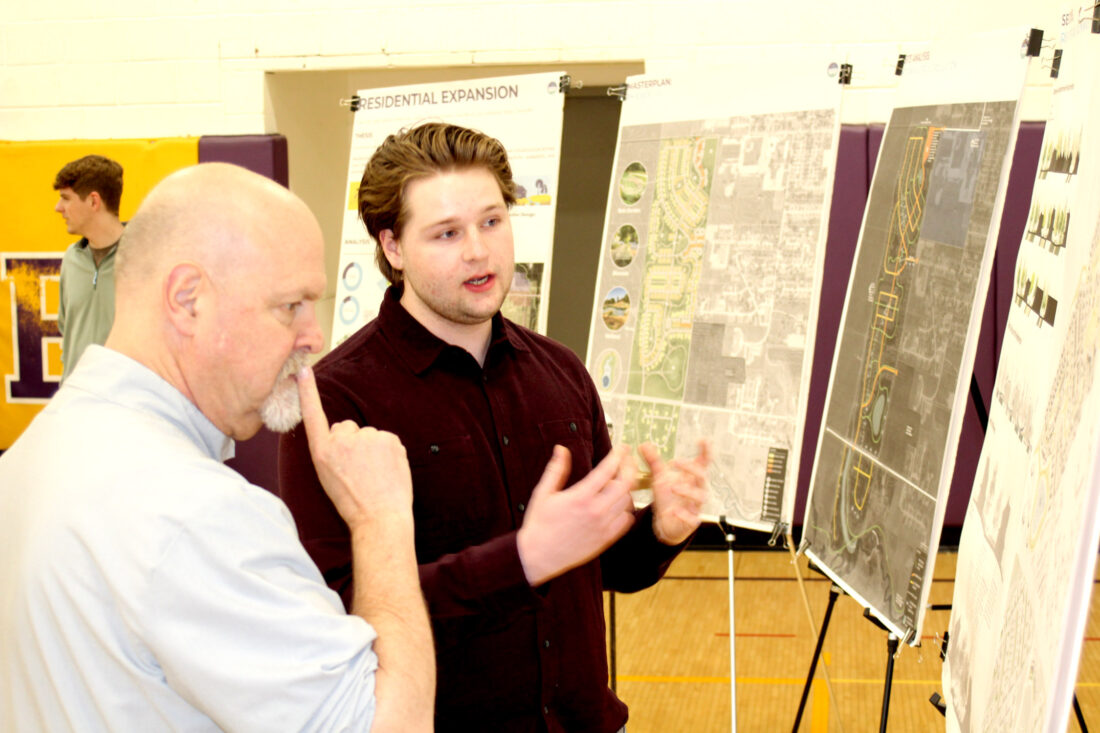
Freeman-Journal photo by Robert E. Oliver<br>Councilman John Marvel listens as ISU fifth year architecture student, Michael Folson, right, explains his ideas for an all new residential neighborhood on Webster City's west side.
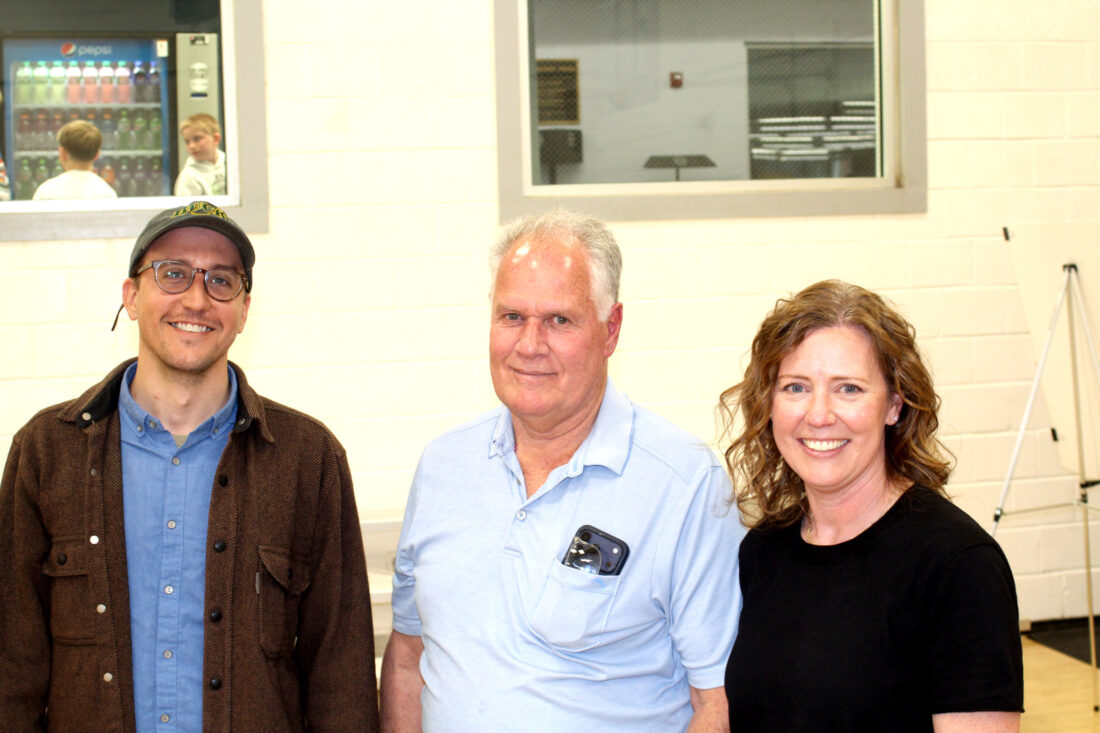
Freeman-Journal photo by Robert E. Oliver<br> Mayor John Hawkins, center, shown here with Professor Austin Dunn, left, and Dr. Sara McMillan, right, of Iowa State University, spent the afternoon discussing the concepts presented for Webster City's future with many of the 35 ISU students who worked on the project.
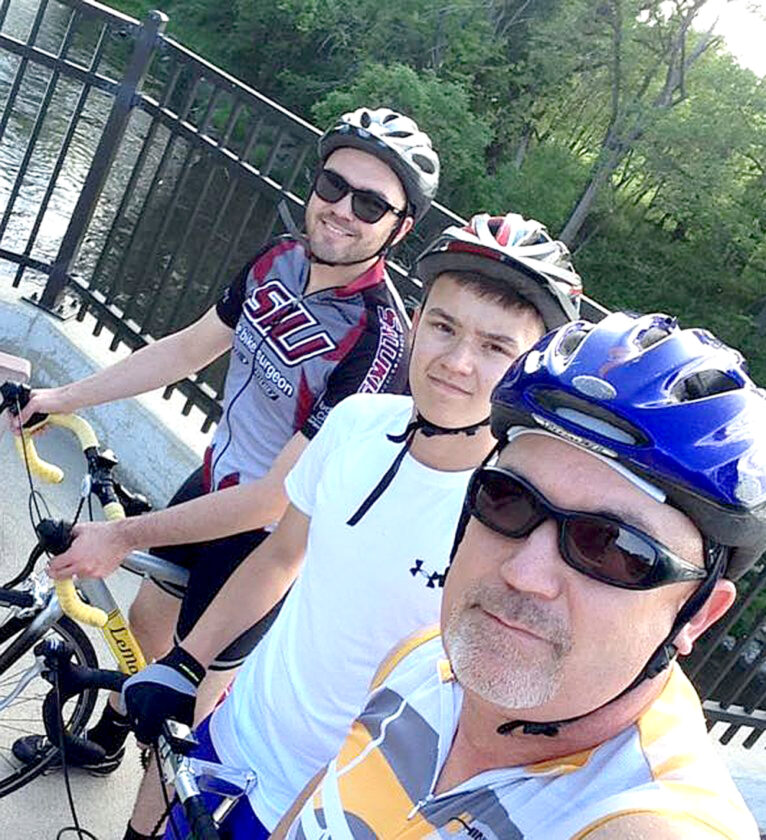
Submitted photo<br> "Brady, Max and Kent Harfst interrupted a ride on the Boone River Trail to have this photo taken on the trail's bridge over the river just north of Briggs Woods Park. Kent Harfst was the driving force behind creation and construction of the trail."
Freeman-Journal photo by Robert E. Oliver<br>Councilman John Marvel listens as ISU fifth year architecture student, Michael Folson, right, explains his ideas for an all new residential neighborhood on Webster City's west side.
Freeman-Journal photo by Robert E. Oliver<br> Mayor John Hawkins, center, shown here with Professor Austin Dunn, left, and Dr. Sara McMillan, right, of Iowa State University, spent the afternoon discussing the concepts presented for Webster City's future with many of the 35 ISU students who worked on the project.
Submitted photo<br> "Brady, Max and Kent Harfst interrupted a ride on the Boone River Trail to have this photo taken on the trail's bridge over the river just north of Briggs Woods Park. Kent Harfst was the driving force behind creation and construction of the trail."
Trending
If ever there was a "Webster City year," it was 1986. A.B. Electrolux acquired White Consolidated Industries and announced plans to spend $90,000,000 on a state-of-the-art laundry appliances factory here.
Suddenly, there were new kids in schools; new faces in church; the Newcomer's Club was full of folks who came to town to be part of the great adventure.
Webster City was growing in both population and prosperity.
About the same time a young man who would play an over-sized role in Webster City, the late Kent Harfst, dreamed of building a trail along the Boone River from Nokomis Park to Briggs Woods. The city council approved the concept in November, 1996 but the 5.7-mile concrete trail wouldn't be formally dedicated until 12 years later on September 24, 2008.
Harfst persisted throughout the process, teaching himself the language - and strategy of successful grant writing. But his greatest asset was his plain-spoken honesty, and the integrity that marked every aspect of his life both personal and professional. People backed the idea because they believed in Kent.
Harfst always hoped to tie-together the Boone River and Brewer Creek Trails; safely separated from the traffic, and danger of city streets. Ironically, this man who dreamed of trails where families could safely walk and cycle died in a violent crash while riding his bicycle on a remote county road in northwest Iowa.
Now Mayor John Hawkins has become the champion of seeing Harfst's dream of connected trails through to completion.
"All I have to do is package this idea up and sell it," he laughed.
Last summer Hawkins joined mayors of five other Iowa cities at Iowa State University's Mayor's Design Workshop. Each mayor presented the student design teams with a list of projects their respective communities must resolve in the future. Critically, ISU wanted to know the most "complex" problems facing each city.
"There were several big projects I thought about," Hawkins said, "but settled on finding a way to take the Brewer Creek Trail down to the river and connecting it to the Boone River Trail."
What's complex about that, you ask?
Today the Brewer Creek Trail ends at Des Moines St., less than a mile from the Boone River Trail. To get there - safely - the Brewer Creek Trail must (safely) cross Des Moines St., Willson Avenue, and Superior Street, cut across privately-owned land, and finally, cross the Union Pacific Railroad tracks.
Of the three streets the trail must cross, Superior is the busiest, with 5,000 vehicles using it daily. The ISU team felt both Des Moines St. and Willson Avenue could be crossed at grade, protected by so-called "zebra crossings," prominent flashing lights that require cars to come to a complete stop before continuing. A tunnel, carrying Brewer Creek and the trail on its north bank, is the preferred solution for crossing (under) Superior Street.
Yesterday, a team of 35 ISU students who worked on the projects, came to Fuller Hall to present their findings. They included graduate and undergraduate students in agricultural engineering, biosystems engineering, environmental science, architecture and landscape architecture. The students have worked on the Webster City design projects since the spring semester began January 15.
In addition to the trails project, the students also made recommendations on other issues. Those include improving the hydrology of Brewer Creek, as it is too wide in some places, too narrow in others; what Gateway Industrial Park might eventually look like; and how Webster City might be expanded with all-new residential neighborhoods to the west.
City Manager John Harrenstein reviewed the projects with the students who worked on them.
"There are some truly great ideas for us here," he said, " I could get behind every one of these projects."
As big a project as it would be, Hawkins doesn't want to stop with simply connecting the trails. He'd like to extend the Brewer Creek Trail west of its present terminus at Beach Street to the Kading apartment development north of west Wall Street, opening the city's trails network to thousands more potential users.
It's a move Kent Harfst himself might have suggested.