
1869: The year that put Webster City on the map
Trending
Even if American history wasn't your favorite class, there are some dates you may remember. Here's an easy one. July 4, 1776. That's when the Continental Congress adopted the Declaration of Independence. December 7, 1940? The attack on Pearl Harbor that brought the U.S. into WW2.
Then there's May 10, 1869? That was when a railroad spike of 14 Troy ounces of California gold was driven into a railroad tie of laurel wood, marking completion of the first transcontinental railroad. The first? Five more would be built, but to most Americans, only the first is remembered.
That day, two railroads met on a barren, windswept mountain pass at Promontory Point, Utah: Union Pacific, building west from Omaha, and Central Pacific, building east from Sacramento.
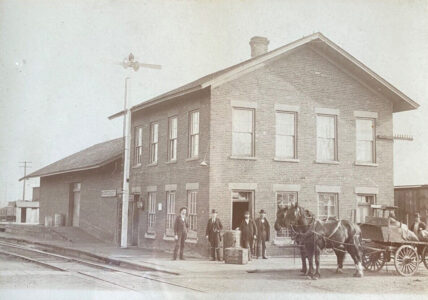
How about April 6, 1869? Here's the headline of that day's Hamilton Freeman: "The Iron Horse Crossed the Classic Boone (River), and Came Snorting into Webster City."
It was the day that put Webster City on the map. The instrument of destiny was the Dubuque & Pacific RR--D&P which was incorporated in 1853 in its namesake city to build to the Pacific Ocean. Using Pacific in a railroad's name signaled ambition and promise. Most, including the D&P, got nowhere near blue water.
The railroad made steady progress. In 1857, track reached Dyersville, 29 miles west of Dubuque. Dubuque steamboat owner and D&P President, Jesse Farley, took the opportunity to name a hamlet six miles east of Dyersville for himself; thus Farley, Iowa was born.
By 1861, the railroad steamed into Cedar Falls. The Civil War suspended railroad building nationwide, but by 1866, D&P rails had been laid further west to Iowa Falls.
Here, Walter C. Willson enters the picture. Arriving in 1855, five years after founder Wilson Brewer, he bought Brewer's entire plat for $22,000. Wilson's first enterprise was a water-powered sawmill on the Boone River. Later, it was set up to mill corn into flour.
Impatient with the slow progress of the D&P, in 1866, Willson met D&P's chief engineer, John I. Blair, asking when the line might reach Webster City. He came away with a contract to build the railroad himself, and did so, from Alden to Webster City. In 1867, the D&P was absorbed by the Illinois Central--I.C.
Webster City, now connected to America's 47,000 miles of track, began seeing immediate benefits of its railroad. Settlers, previously facing weeks in a covered wagon struggling over dusty or muddy ruts that passed for roads, could now reach Webster City in comparative safety and comfort only two days after leaving Chicago.
Daily deliveries of the U.S. Mail now arrived weeks faster than before. Everything needed to set up a farm or home in town could be readily and inexpensively shipped in boxcars.
Three more railroad-related businesses began serving Webster City in the next few years. American Express Company ran its own express cars on I.C. passenger trains, hauling parcels from Webster City to its 23,000 offices across the U.S., Canada and Mexico, the forerunner of today's United Parcel Service and Federal Express.
Western Union established telegraph service at the I.C. depot, providing the miracle of nearly-instantaneous communication decades before long-distance telephone service. Its uniformed "telegraph boys" delivered telegrams all over town on bicycles into the 1960s.
Finally, the Pullman Company's comfortable sleeping cars provided luxurious travel throughout North America. Illinois Central's fine overnight train, "The Hawkeye" took Webster Citians to Chicago where sleeping car services ran to every state in the Union and every Province of Canada. By the 1920s, over 100,000 people traveled in Pullman sleeping cars every night, making it the nation's largest "hotelier."
Few inventions, entities or businesses survive 220 years, but we can easily conclude railroads remain vital to America, Iowa and Webster City in 2026. Consider Iowa's two main commercial crops: corn and soybeans. According to industry trade journal Freight Waves, 24% of domestic grain movements and 39% of grain shipments for export, moved by rail in 2025.
The Soy Transportation Coalition says "class one railroads move approximately 67% of soybean oil in the United States." Every day soybean oil made in Eagle Grove passes through Webster City in trains. Each year Iowa produces 4.6 billion gallons of ethanol, but only 4% is consumed locally. About 60% of the rest goes to market nationwide by rail.
Finally, Webster City's new Gateway Industrial Park is competitive with other sites, in part because of access to Union Pacific Railroad service.