
Nitrates reduced, flooded roads to cease if wetland project moves forward
County supervisors hold public hearing to hear solutions
Trending
The Hamilton County supervisors held a public meeting last week to address an ongoing problem within one of the drainage districts in Hamilton County.
The area of concern is a drainage district project southeast of Stanhope. After notifying all the property owners in the district, they held their first public hearing. There are about 2,500 acres in this one district.
The land, which has been farmed by a number of different farmers, has historically been drowned out most years.
"This is probably the least productive farmland in the county," said chairman Rick Young. "If there is over two inches of rain, it closes the road."
The land, which is just off of Olsen Avenue, has been studied by the Great Outdoors Foundation and engineers from Bolton Menck.
Currently, 40 acres are owned by the drainage district. A total of 80 acres are considered non-productive and would be considered part of a project to recreate a wetland area, which would solve both water quality issues, and road issues. The adjacent owner of the remaining portion of ground already has some of his land in CRP, a slightly different program run through USDA. That landowner has already indicated his approval for this project.
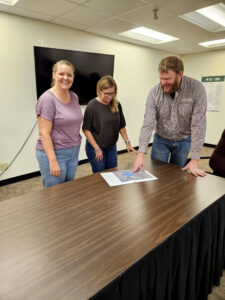
Sara Carmichael, of the Great Outdoors Foundation, Staci Williams and Jon Rosengren, of Bolton Menck Engineering, were on hand to explain the role that they can play in turning the ground back into wetlands.
If all things come together, the Great Outdoors Foundation would provide for a perpetual easement payment, which would be different from the money that restores the wetlands. Bolton Menck would plan how the wetland would be designed. If the project is approved by all the appropriate partners, it will be paid for by the Iowa Department of Land and Stewardship, a state entity that is a division of the Iowa Department of Agriculture that helps rebuild wetlands.
Rosengren presented the recommendations to the supervisors.
"Turning it back into wetlands will break down the nitrates," he said, "Wetlands are good to reduce nitrates and they will help bring natural microbial bacteria activity to the surface."
The existing old tile mains can handle enough water for the remaining areas, he said.
The proposal is to permanently retire farming the land in the entire 80-acre area. The remaining property will still be owned by the property owners, and they can access the remaining land.
"This would be the first project like this in the county," said Young, "It's a great project to improve the water quality for the county."
Projects like this are being considered all throughout the state of Iowa, as concerns for water quality and nitrates continue to be discussed.
According to Carmichael and Rosengren, land along creeks and rivers that are undisturbed already probably have native grasses, which do the best job of drawing nitrates away from waterways.
The supervisors are the trustees for nearly all the 320 drainage districts in the county.
"I've talked to nearly all the landowners in the district and they are all for the project," said Young.
The work that is needed must be approved by the trustees of the district, the Iowa Department of Land and Stewardship and the Great Outdoors Foundation.
The project was approved for future steps by the trustees.