
City will borrow money from state fund to build wastewater plant
Trending
The City of Webster City is applying for a loan from the Clean Water State Revolving Fund to finance rebuilding of the wastewater treatment plant. The fund helps Iowa cities pay for design and construction of wastewater, stormwater and sewer utilities.
Before the state can approve a loan for the project, Webster City must file an Environmental Information Document (EID), and hold a public hearing to allow comments on the project. That hearing took place at the June 15 meeting of the City Council of Webster City.
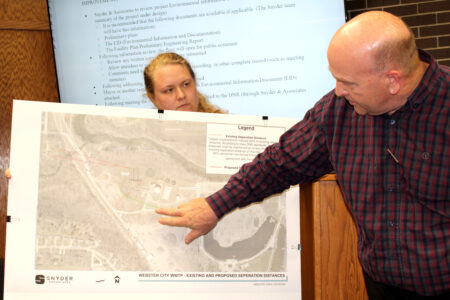
No one attended the hearing to comment, but an email from a Webster City resident asked if the project met DNR's separation requirements. These stipulate a wastewater facility be located no closer than 1,000 feet to a home or commercial premise. When wastewater facilities are being expanded, as in Webster City's case, the DNR can relax the separation requirements to 90% of 1,000 feet.
Darin Jacobs, P.E., who's leading the wastewater project for Snyder & Associates, the city's consultant, said the city of Webster City "meets all requirements to build the new plant, including separation requirements." Jacobs noted that the primary clarifiers now in service at the plant and closest to residences on Edgewood Drive, will be "taken out of service" in the redesigned plant.
Council authorized the city manager to submit the EID, thus initiating the loan process. The Iowa legislature established the Clean Water State Revolving Fund in 1988. Jointly administered by the DNR and Iowa Finance Authority, the fund is "revolving" in that as some cities repay their loans, the proceeds are used to underwrite new loans for other cities.
Jacobs briefly described the rebuilt wastewater plant as follows: "the new wastewater treatment process will generally include extensive renovation and upgrade of the existing headworks, a new grit removal system, a new Sequencing Batch Reactor (SBR) based activated sludge treatment system, and renovation of an existing digester equipment-laboratory building and related anaerobic digesters." The existing chlorine storage and control buildings will also be renovated. The entire footprint of the plant will move generally further eastward on city-owned land.
The city has hired Woodruff Construction of Fort Dodge as construction manager-at-risk to manage construction. Under its contract, Woodruff must quote a guaranteed maximum price for the project, while delivering agreed-upon specifications and capabilities.