
When the dragoons explored Iowa
Trending
In 1834 when the 1st U.S. Dragoon Regiment passed through the area, no one would have envisioned the growth over the next 150 years.
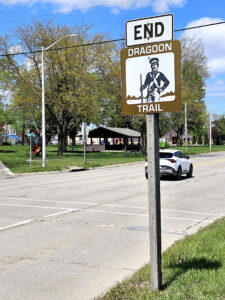
Webster City sits where the dragoons ended their exploration in 1835. There are two types of markers within the city today; one erected by the Iowa Daughters of the American Revolution at the northeast corner of the Kendall Young Library. The second marker is a brown and tan highway sign that marks the end of the trail near the East Twin Park.
Most have driven or walked by these signs and not thought about what they signified.
The dragoons were men recruited by Capt. Nathan Boone, son of Daniel Boone, who sought individuals to shift from frontiersmen to soldiers. But he didn't lead those he recruited to go into battle. Their role was exploratory and defensive. This task was assigned to Stephen Kearney.
Lt. Col Stephen Watts Kearney had served in the war of 1812, but after the war ended in 1819, he became a member of the Yellowstone Expedition and was assigned to the frontier.
A career U.S. Army officer, he was part of the team exploring the west, subsequently reporting of the great prairie between the two major rivers, now known as the Missouri and the Mississippi, in addition to communicating other information such as the populations of wildlife living in the habitat.
In 1820, Lt. Kearney estimated a herd of nearly 5,000 bison lived near the Little Sioux River, in addition to dense populations of elk and deer.
By the time Boone had recruited men to serve, Kearney had an idea where they were heading. Seventy-eight men reported for service on the bank of the Mississippi River, and were taken to the newly founded Fort Des Moines in the fall of 1834.
The outpost was made up of tents and scattered supplies. Their initial tasks were to create log quarters for the men, to create shelter for the Midwest winter. It wasn't until June of 1835 that they were led into the 1,100 miles of prairie, reporting on rivers, plants, wildlife and people.
According to the Iowa History Journal, the regiment scouted the territory of Iowa in the summer of 1835, following the Black Hawk Purchase of 1832. By then, Kearney had been promoted.
Col. Kearney led the infantry unit's explorations, and they were able to create several outposts from Fort Dodge and Webster City through Des Moines, Pella and Knoxville. The trail markers follow along the Des Moines, Boone and Raccoon rivers.
Amongst the regiment was Lt. Albert Miller Lea, who was a topographer. At the time of their travels, the land was an unbroken territory, and their task was to map, measure and make contact with indigenous people who made their homes in the area.
It is estimated that as many as 28 to 30 million acres of prairie covered the Iowa heartland. Inhabitants included the Dakota, Sauk, Meskwaki, Ioway, Otoe, Missouria, Potawatomi, Ho-Chunk and others. They had shaped and stewarded Iowa's lands, and they tended the land with fire, ceremony and communal care. The seat of tall-grass prairie and forest of oak, hickory, maple and cottonwood shaded the river valleys.
As the dragoons prepared to take the first American military expedition across the state, they did not anticipate the abundance, and careful balance that had kept wetlands, rivers, prairies and wildlife healthy. Their work mapping the area would change the landscape and the habitat as settlers would follow the Dragoon Trail and create settlements which would alter the balance so carefully preserved.
The dragoons' march and mapping opened new routes for wagons and cleared acres for plows.
By 1860, nearly 750,000 settlers arrived to find their own fields of opportunity.
As for the dragoons, many left the ranks to become farmers. All that remains of their work are the scattered signs marking the Dragoon Trail.
Special thanks to the Fort Dodge Fort Museum for the Dragoon map. Be aware rivers have changed, and some routes may be impassable. Also thanks to the Iowa History Journal and author Kevin Mason. For more information, he has a new book called “Retracing the Dragoon Trail in Iowa.” that is now available).