
Early railroads met opposition within Hamilton County
Trending
Editor's note: Over Hamilton County's efforts the railroad expansions were controversial; as the following history which was largely from the Hamilton County History accounts written by J.W. Lee. But these transportation legs were critical for the business and community to grow, and appeared to often be protested by the rural residents trying to protect their farmground. Multiple railroads attempted to move into the area, but in the end only one prevailed.
In the spring of 1881 it was reported that the Chicago, Milwaukee and St. Paul Railroad had decided to build a railroad line from Plymouth, a point near Mason City, to Council Bluffs and that it would cross the Illinois Central Railroad within twenty miles of Webster City.
Committees were appointed and attempts were made to attract this road to Hamilton County, but the attempt failed.
In the fall of 1881, however, the Crooked Creek Railroad proposed to extend it's line to Webster City if the people would secret the right of way, grade the same, and secure depot grounds. The railway company's part of the enterprise was five percent tax by the townships it crossed by the road. This would raise the funds that were necessary.l
Voting for a tax could not be submitted while the tax levy voted for the benefit of the Toledo and Northwestern Railway stood. Since the Northwestern Railway did not intend to accept the tax, the company was asked to release the levy.
In the following year, there was a notice published that there was to be a special election of the voters of Boone township. This was to vote for a five percent tax to construct the Webster City and Southwestern Railway.
The Webster City & Southwestern Railway company was to build the Crooked Creek extension. W.C. Willson was president of this company. The fact that he was urging the tax was enough to guarantee the opposition of the downtown community, and the word went out that people were being asked to vote and pay for a "stub" coal road. Boone township included a large amount of farming ground, and the farmers opposed the tax. The election resulted in a defeat of the tax by a vote of 401 to 260.
Later, in October of 1883, the tax was again submitted, asking for a three percent tax, and this finally carried by a vote of 326 for, to 31 against. As a three percent tax from Boone township was not sufficient, nothing happened.
A final effort in 1886 was again submitted asking for a five percent tax, which was approved 308 for and 228 against.
TFinally after voting the aid to the Crooked Creed, an engineering team from St. Louis, Des Moines and the Northern Railroad made a preliminary survey through Hamilton County. The proposed line would have entered the county near Stratford, bore a little east of north, crossed the Boone river near Bells' Mill and pass through the western part of Webster City. It would have left the county near the northeast corner of Cass township.
The railroad company offered to bring the road to Webster City and establish a division for $40,000, $25,000 to be subscribed for stock of the company, and $15,000 to be given as a cash bonus.
Since a 5 percent tax had just been voted to the Chicago Central Railroad, no tax could be voted for this new effort.
So a public meeting was called to figure out a way for the new railroad company to make a move. The meeting was well attended by both uptown and downtown groups and it managed to determine after an hour and a half meeting that they would be able to work together.
They decided to secure a relinquishment of two percent of the tax voted to the Chicago Central Railroad, which would raise about $15,000 and to raise $10,000 by taxation.
A private subscription began, with Willson, Funk and Estes each donating $1,000 and they had $6,000 committed during the meeting.
In the meantime, the vote needed to be taken in other parts of the county. One would be in Marion township and Webster township.
The Marion township tax was defeated by 3 votes. This discouraged the railroad company, and before Webster township had a chance to vote, the railroad withdrew their plans.
Several lawsuits were starting to erupt ,and there were petitions circulating, despite the fact that nearly all the money had been raised to complete the plans to come through Hamilton County.
Willson, D.D. Chase, and W.J. Covil ended up on opposite sides of the propositions, and deals were bantered about, struck, withdrawn then resubmitted.
All efforts to bring either of the original two railroads into Hamilton County were abandoned. But the taxes had been collected, and the efforts to tie up those funds to be used in other efforts were attempted.
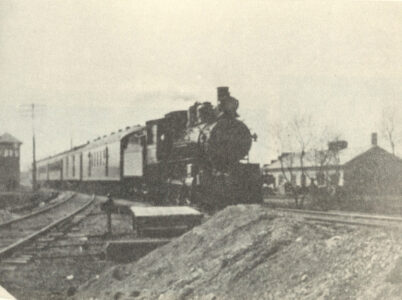
Despite those attempts the Webster City and Southwestern Railroad Company was approved by Judge Weaver and on appeal, was sustained by the Iowa Supreme court. This resulted in a line coming from Lehigh to Webster City which was completed in 1887.