Seamless transition for countywide dispatch
After a long road, finally a reality
-
-
—Daily Freeman Journal photo by Lori Berglund
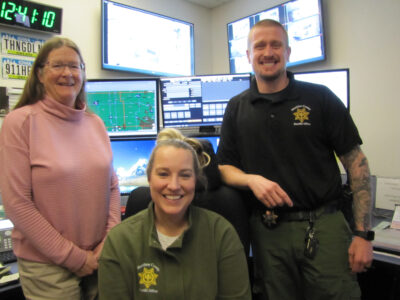
Dispatchers cannot leave this small space during their eight-hour shifts. In front of them are at least five screens, along with additional screens mounted higher in the county-wide dispatch center at the Hamilton County Courthouse. Checking out the space, from left, are Communications Director Luanne Paper, Lead Dispatcher Susan Burke, and Hamilton County Sheriff Alex Pruismann.
—Daily Freeman Journal photo by Lori Berglund
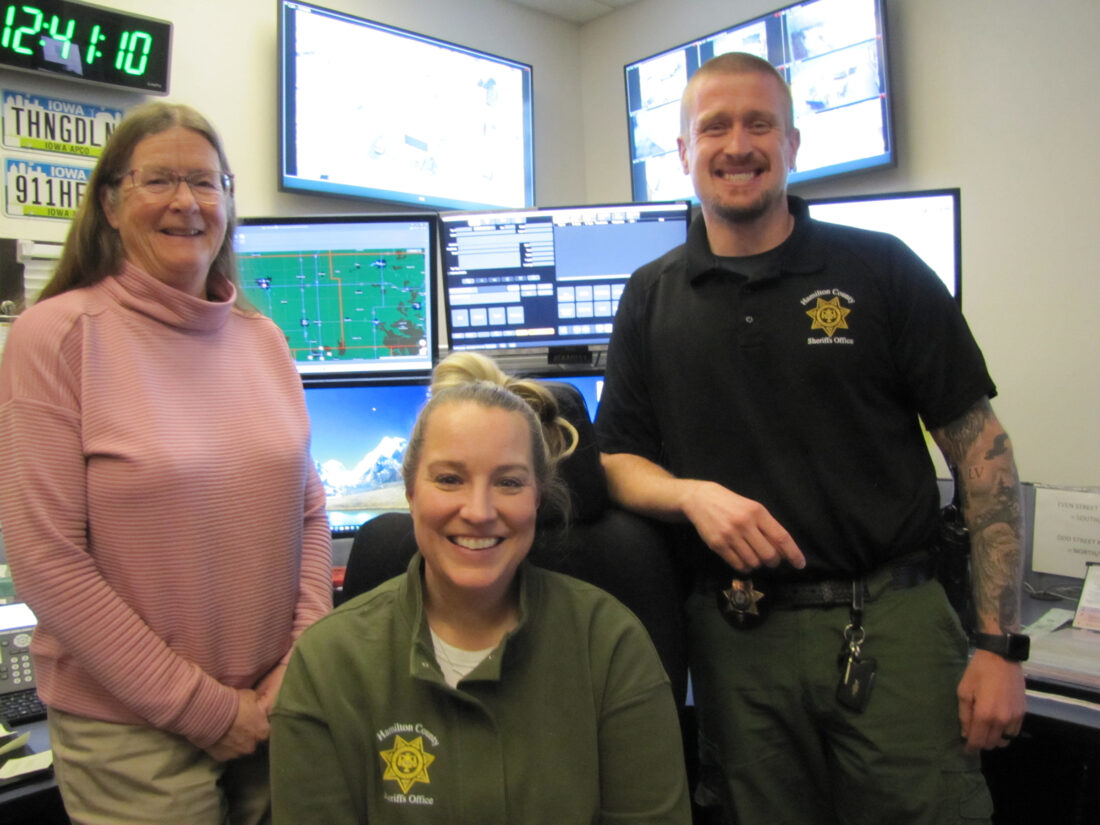
Dispatchers cannot leave this small space during their eight-hour shifts. In front of them are at least five screens, along with additional screens mounted higher in the county-wide dispatch center at the Hamilton County Courthouse. Checking out the space, from left, are Communications Director Luanne Paper, Lead Dispatcher Susan Burke, and Hamilton County Sheriff Alex Pruismann.
It’s been decades in the making, but seemed to come together at the last minute, in the blink of an eye. For Hamilton County Sheriff Alex Pruismann, Communications Director Luanne Paper, and Lead Dispatcher Susan Burke, the transition to a complete, countywide dispatch center in the last few months has been at times challenging, but always rewarding.
“It happened in about six months total,” Pruismann said. “That’s a very quick amount of time for the amount of work that had to go on behind the scenes.”
Six months … and about three decades, for those familiar with the long-haul story of bringing Enhanced 911 — E911 — service to Hamilton County, beginning in the early 1990s. The late Jerry Farnham was Hamilton County Sheriff. Mike Petricca was chief of police for the city of Webster City, and a countywide board worked through a long series of intense sessions to bring the vital service to all of Hamilton County.
E911was ground-breaking at the time because it was not just a quick way to call for help. It gave the dispatcher on the other end the Automatic Number Identifier and Automatic Location Identifier. With this technology, even if the caller could not speak for whatever reason, the dispatcher knew exactly where to send help. This enhancement is the “E” behind E911 and revolutionized emergency response capabilities nationwide.
It was the job of the Hamilton County E911 Board to bring that service to county residents. The debate was where to put the technology and where to locate the dispatch center.
With five successful elections behind him as Hamilton County Sheriff, Farnham had the experience and political clout to know that the best location at the time was not at the sheriff’s office, but at the Webster City Police Department.
“It belongs down there (at the police department), because that’s where the jail is,” Farnham, in his very succinct manner, told the press at the time.
Basic dispatching services were already handled for both the city and county out of the police department. Deputies were on duty 24/7, but the sheriff’s office was not staffed 24 hours, so the first countywide dispatch was actually at the Webster City Police Department many years ago.
The jail was a bare-bones, 24-hour, five-cell holding facility and it was the only place in Hamilton County to hold prisoners. The jail had to have a 24-hour staff, hence the logic of putting 24-hour dispatch in the same location.
The construction of a full-service jail in 2004 would prompt the move of the E911 dispatch center from the city to the county. Scott Anderson was Hamilton County Sheriff during this pivotal time. Working with county supervisors and the E911 Board, he led construction of the jail and organization of the dispatch center, and then handed it off to incoming Sheriff Denny Hagenson in 2005.
“Everything was in place, but the key wasn’t turned until Hagenson came in,” recalled Anderson.
It was Hagenson who opened the facility in March 2005. Paper, who had been hired by Farnham in 1978, was there for it all, and is still there today, shepherding yet another major transition for the sheriff’s department. In the intervening years, Sheriff Doug Timmons put in his time at the helm and then welcomed Pruismann as sheriff at the beginning of 2025.
But while E911 service moved to the sheriff’s office in 2005, the city maintained its own 24-hour dispatch center at the police department. All 911 calls were answered at the county, while non-emergency lines were answered by city dispatchers. It was an independent consultant brought in to review and look for efficiencies with the Webster City Police Department who recommended the consolidation of all dispatching at the Hamilton County dispatch center.
“The police department was going through a transition with their leadership,” Pruismann noted. “They brought in a consultant and one of the recommendations was to combine dispatch because it was redundant. At that point in time, Acting Chief (Eric) McKinley and I started talks and I brought Luanne (Paper) in because she had been through this in prior years. We got the ball rolling, and once Chief (Steve) Hanson was hired he continued it.”
Both Pruismann and Hanson were in their first year in their respective positions, but with the assistance of people like Paper and Burke were able to make the transition run smoothly.
Paper makes the important distinction that the county facility has actually answered all the 911 calls since 2005. It is only the non-emergency, administrative calls that were added to the workload, but that’s not a small number of calls. Burke estimated that call volume has as much as doubled since the change-over on Sept. 15, 2025.
Not only is it a larger number of calls, but they are also different types of calls. In the city, a typical animal call is a problem dog. In the county, a typical animal call may be a cow on the road. Both can pose dangers to the public, but dog calls are more frequent, according to Pruismann.
“We have about 15,000 people in the county, of which about 7,500 people are in the city, we are just adding their calls,” Pruismann said.
While call volume has doubled, the staff has grown only slightly, from eight full-time dispatchers previously, to a new staff of 10 full-time dispatchers. The goal is to always have two dispatchers on duty.
“They are trained completely differently,” Pruismann explained. “Our dispatchers are trained on 911 and EMD, which is Emergency Medical Dispatching. They essentially have to learn a whole new job out here.”
EMD is a card system that allows dispatchers to flip through a series of cards and walk callers through almost any medical emergency until help arrives.
The accomplishment of successfully moving countywide dispatch under one roof is not lost on Paper, who has seen it all in more than 40 years at the Sheriff’s Office.
“It should have happened a long time ago,” she said. “I am really surprised that we were able to get this done as fast as we did. I would have said it would take a year, just because of all of the procedural changes and getting people trained.”
As for the future, Pruismann, Paper and Burke agree that renovations will be needed to the now 20-year-old dispatch office. The L-shaped room is surprisingly small and windowless.
“A lot of people don’t realize that once dispatchers are in that room, they can’t leave,” Pruismann said. “Two people are in there with two full computer systems. It’s tiny, there’s a bathroom and refrigerator. Eventually we will need to remodel and somehow give them more room.”
While work behind the scenes has taken place in a flurry, county leaders are pleased that, by and large, the public hasn’t noticed the difference. That was the goal, to provide a seamless transition, saving taxpayer dollars and streamlining services under one roof.
“It’s not perfect, but we’re getting there,” Pruismann concluded.