Music makes the school well-rounded
Math, sports and other academics can be positively impacted by participation in a music program
-
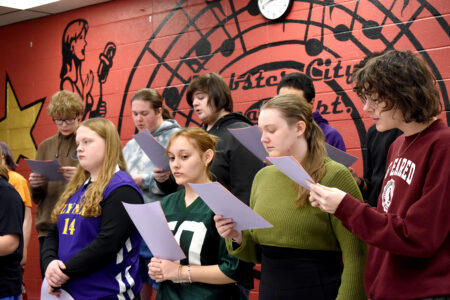
- —Daily Freeman-Journal photo by Kolleen Taylor While the boys sing, the girls in the varsity chorus wait, watching for their chance to join in. From left to right, front row: Amanda Lahr, Ash Tinoco, Rinoa Raygor, and Jackson Meyer. Back row: Brayden Geerdes, Gryffan Stevens and Connor Caquelin.
-
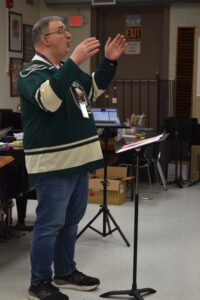
- —Daily Freeman-Journal photo by Kolleen Taylor Aaron McCullough directs his students during a rehearsal of the one of the choirs at the Webster City High School chorus room. Josi Greenley provides piano accompianment both in practice and performances. Currently the vocal students are practicing for the “Singing Valentine” fundraiser.
-
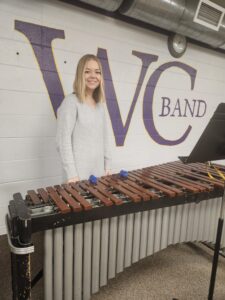
- Daily Freeman-Journal photo by Kolleen Taylor Kaitlyn Abens is the Webster City High School Band director. A graduate of WCHS, this is her first year directing band, and the number of students in the band has increased since the beginning of the year.
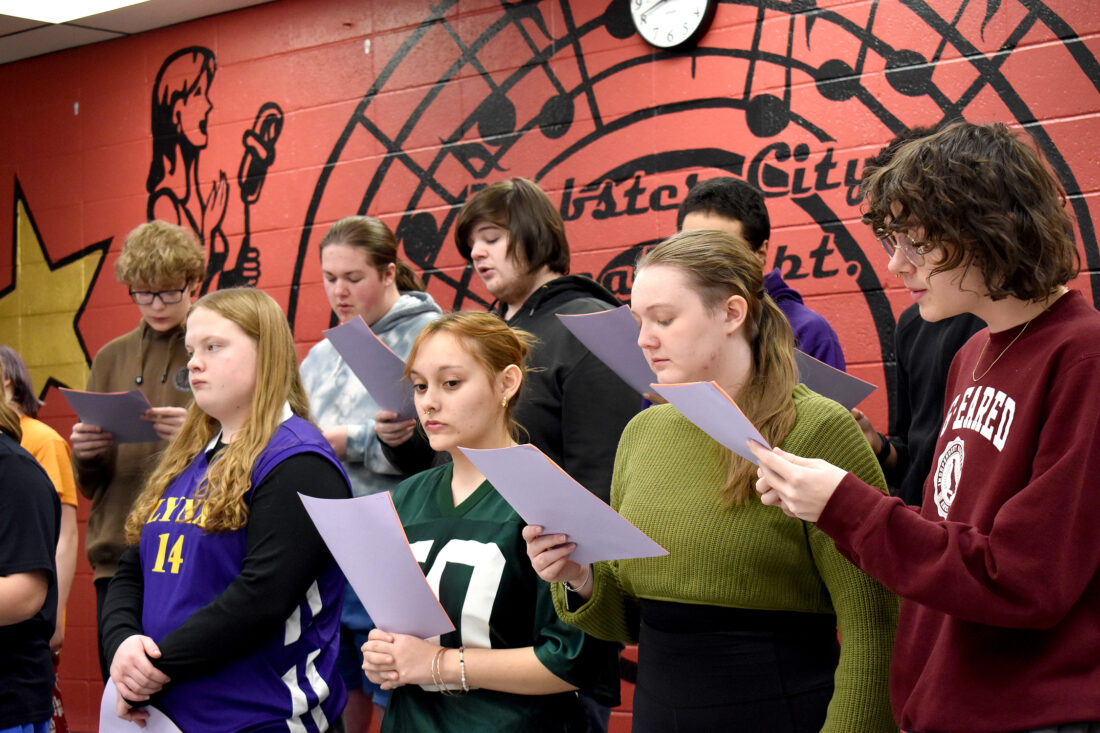
—Daily Freeman-Journal photo by Kolleen Taylor While the boys sing, the girls in the varsity chorus wait, watching for their chance to join in. From left to right, front row: Amanda Lahr, Ash Tinoco, Rinoa Raygor, and Jackson Meyer. Back row: Brayden Geerdes, Gryffan Stevens and Connor Caquelin.
Music makes the world go round, but in the Webster City Community Schools, the music helps connect the students with the classroom work, opens the brain, and supports the sports and students in all other aspects of the school.
Music programs have come under scrutiny for years, with school boards and other elected officials looking at these costs as an unnecessary part of the school curriculum.
But they have been proved wrong.
Starting as young as kindergarten, music instruction and performance are introduced to the children of our community. Regardless of talent, music brings out the best in our children, helping them understand rhythm, counting and sound combinations.
A study from the Brain and Creativity Institute at the University of Southern California shows that as little as two years of music instruction has multiple benefits. Music training can change both the structure of the brain, which carries signals through the brain, and gray matter, which contains most of the brain’s neurons that are active in processing information.
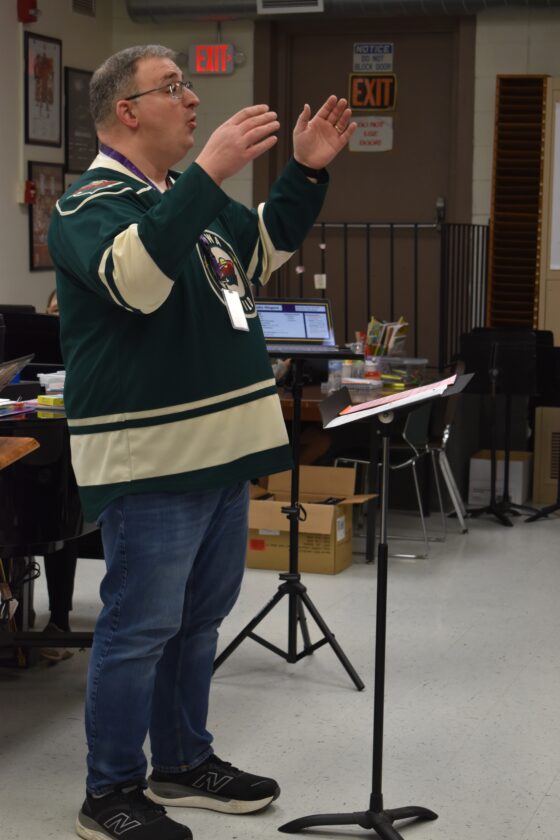
—Daily Freeman-Journal photo by Kolleen Taylor Aaron McCullough directs his students during a rehearsal of the one of the choirs at the Webster City High School chorus room. Josi Greenley provides piano accompianment both in practice and performances. Currently the vocal students are practicing for the "Singing Valentine" fundraiser.
The study of music and its impact on the brain has rejuvenated and returned many programs across the country. But it’s not a promise. Just recently the Boone school system eliminated its string program, which had been running continually for over 100 years due to the economy. But it’s been proven that music can lengthen the life of a healthy brain. The admission from experts along multiple levels of study has kept the music programs in most of the schools in Iowa.
The two high school music instructors Aaron McCullough and Kaitlyn Abens are new to Webster City as they have taken over the vocal and band instruction for the 2025-2026 school year.
Their classrooms sit at the end of the north hall of the high school, nestled behind the stage as a constant reminder that their performances are important. Those rooms have not changed much in the 60-plus years since the building was built.
Serious music students and novices both consider the area a sanctuary, where they can rehearse, study and hone their skills. Both the band and choir rooms are considered safe spaces, welcomed by the directors.
McCullough teaches the vocal music program. He graduated from Iowa State in 2000 with a bachelor’s degree in music education, teaching at Woodbury Central for several years. He also spent one year in a professional program in Creston, and received his masters degree in 2009 in Ohio. He took a full-time church music position at St. Luke Lutheran Church in Columbus Ohio before coming back to Iowa, where he taught for three years at Pocahontas, prior to Webster City.
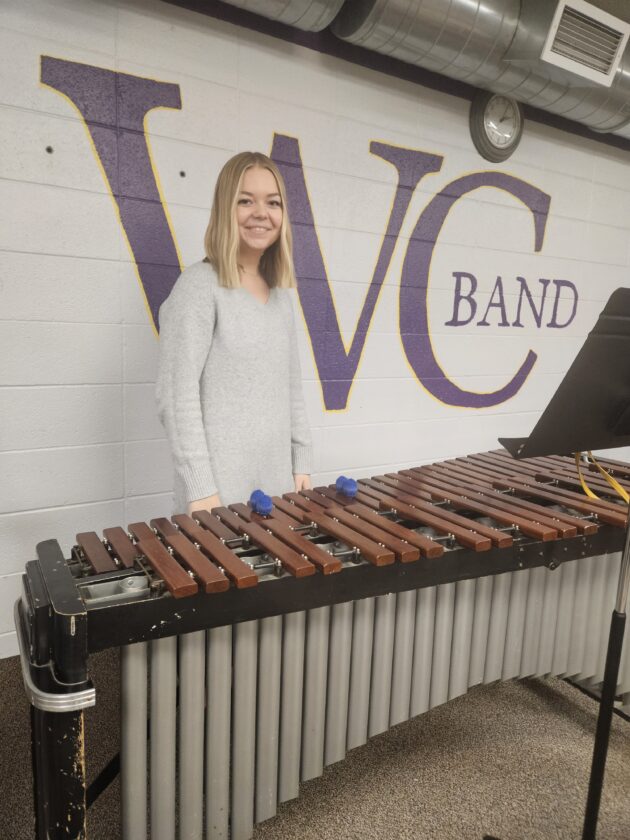
Daily Freeman-Journal photo by Kolleen Taylor Kaitlyn Abens is the Webster City High School Band director. A graduate of WCHS, this is her first year directing band, and the number of students in the band has increased since the beginning of the year.
His experience in Webster City has been very positive.
“Overall, personally I have to give kudos to Greta Nelson for the culture that she has created at Webster City,” he said. “I have been thrilled with the kids in Webster City. They love to sing and work together. That in itself has been a great joy in coming to Webster City.”
He feels that today’s kids have added challenges of technology and more information than any era of students has ever had before and it is continually changing.
McCullough currently teaches four periods, a music theory class and each choir has its own period.
“During my free periods, those are reserved for teaching private lessons to individuals and small groups. Some students who have a full schedule don’t always have a free period that aligns with my schedule. Ideally I would be able to meet with each student 10-15 minutes a week.”
“I have been welcomed so warmly by the community,” he said. “Having a strong music program takes support from the parents and the community. It takes a lot of fundraising to keep the programs going.”
Abens is the band director who is inviting students to join the band.
“It’s never too late to join the band. You can start at any time,” she said. “My job is to teach.”
Abens is a graduate of Webster City High School, after spending early years in Ohio. She attended Iowa State University, graduating in 2023. Abens started working with elementary students at Northeast Hamilton two years ago. Beginning band students start working on skills often in the fifth grade. She said she was excited to realize she will see them through to the end of high school, and is seeing them progress through the middle school band programs now.
She noted that the biggest loss of students in the band program is usually between eighth grade and high school.
“Marching band is a bit overwhelming,” she said, but she encourages students to give it a shot. She acknowledges it is work, but it’s fun work. And if you are in one band, you are in them all.
“Bring your friends, once you try it, everyone enjoys it,” she encouraged. “We have a bunch of students who are new.”
She also encourages adults to pick up an instrument and learn how to play.
Music programs in the schools also help students develop meaningful relationships. Like a sports team, the members of a band or chorus have to work together, to blend, to hit the correct notes, to learn the intervals and assist each other to make music work. According to the National Association for Music Education, schools that prioritize music education have higher attendance rates than those without music programs.
“One thing I’ve noticed in my own kids and students, that would be echoed in Webster City, I certainly notice a difference in students dealing with anxiety,” he said, “There is certainly an uptick. Maybe it is the result of the pandemic, or maybe it is social media.”
McCullough feels the music helps reduce that anxiety.
“One thing I’ve grown to appreciate is the looks on the kids’ faces when they are singing,” he said. “You can sense the joy they have from making music. It definitely adds value to their lives and helps them cope with what they are dealing with for sure.”
The American Psychological Association found that students who participated in music programs also scored significantly higher in math, science and english than those who did not, indicating that music education improves all-around academic achievement.
“The arts; drama, theater, art, music are all important, they are needed for our schools,” said McCullough. “We know we have some good things happening; without continued support, it’s not guaranteed. The support our community gives is vital to keeping our programs strong.”
Progress 2026 Education
Music makes the school well-rounded
Scholarships for 2026 seniors are abundant
Even though we are in the dead of winter, it’s just a few short months before students will be done with the ...

Career Ag Academy now open for inspiration
Iowa Central Fuel Testing Lab debuts
Legacy Learning Boone River Valley awarded Arts & Culture Grant for ‘Sitting on Seneca: Finding Friends’
Creativity, connection, and a deep sense of place come together in the work of Legacy Learning Boone River Valley, ...