Iowa Central Fuel Testing Lab debuts
College is on a growth spurt
-
-
—Daily Freeman Journal file photo by Bill Shea
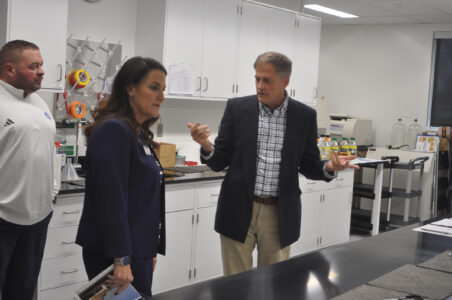
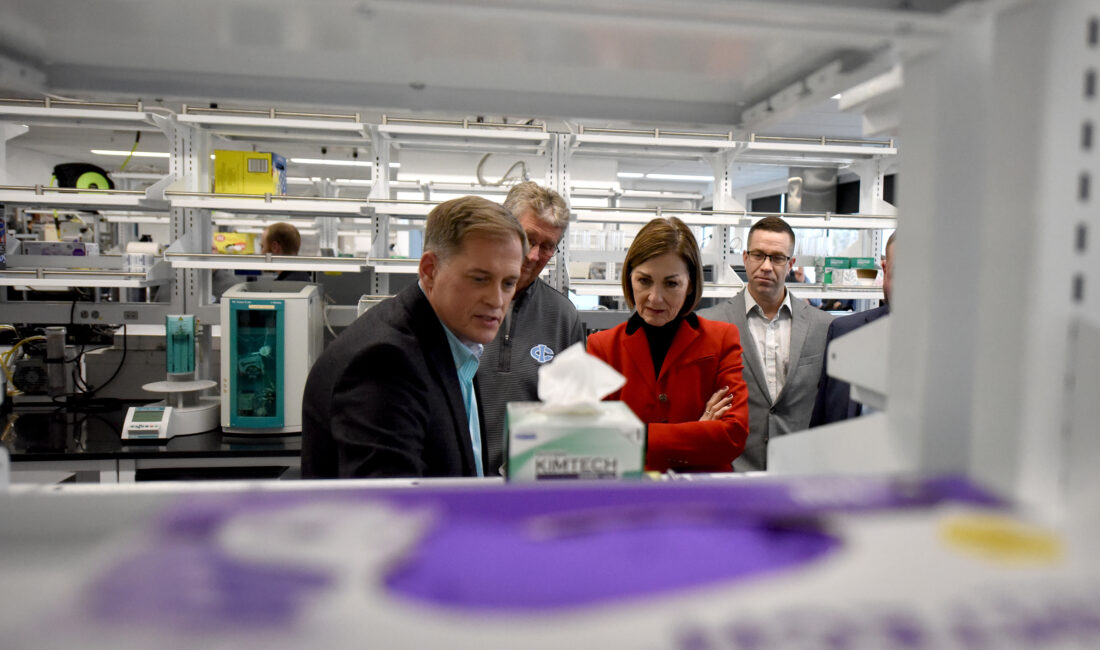
Lt. Gov. Chris Cournoyer, center, looks over some equipment in the Iowa Central Fuel testing Laboratory in November, accompanied by college President Jesse Ulrich, left, and Don Heck, director of the lab.
-
-
—Daily Freeman Journal file photo by Britt Kudla
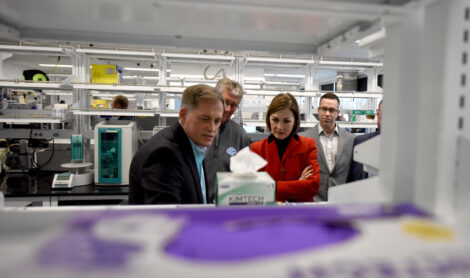
Don Heck, left, director of the Iowa Central Community College Fuel Testing Laboratory, shows Iowa Gov. Kim Reynolds some of the equipment in the new lab in February 2025.
—Daily Freeman Journal file photo by Bill Shea
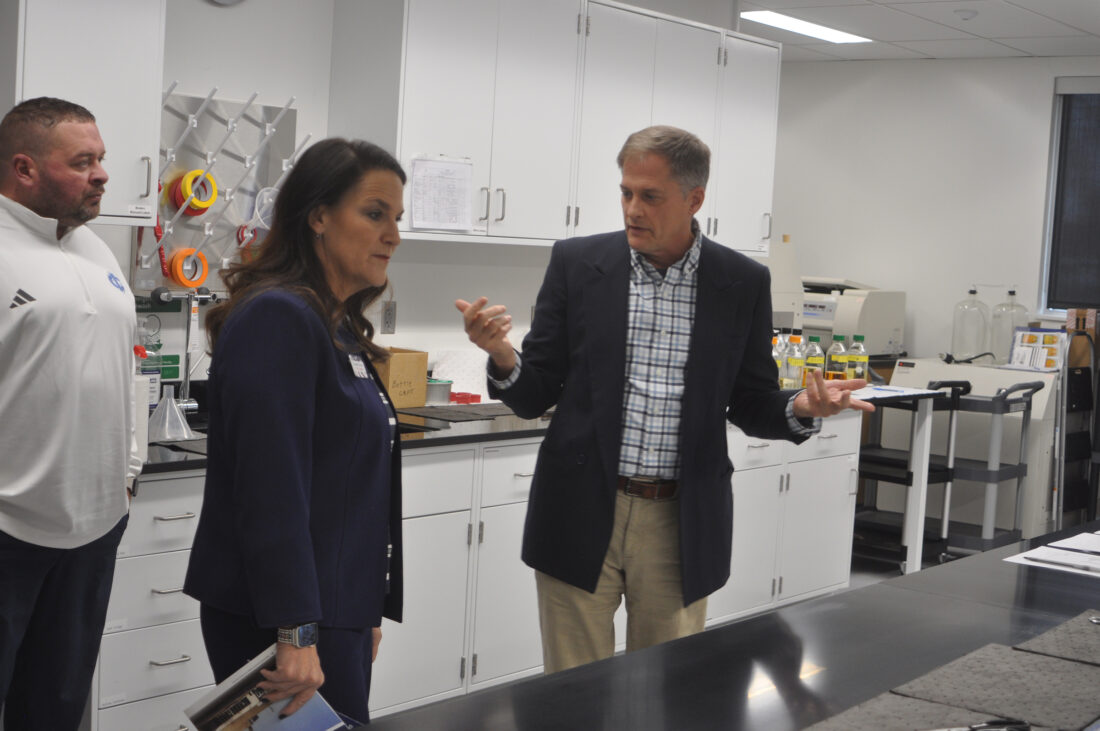
Lt. Gov. Chris Cournoyer, center, looks over some equipment in the Iowa Central Fuel testing Laboratory in November, accompanied by college President Jesse Ulrich, left, and Don Heck, director of the lab.
Every time a driver pulls up to a fuel pump in Iowa, they’re purchasing ethanol, gasoline or diesel fuel that has been quality checked in Fort Dodge.
Those checks are conducted at the Iowa Central Community College Fuel Testing Laboratory. That lab debuted in 2025 in one of the year’s major developments for the college.
Also in 2025, voters in nine counties approved an extension of a borrowing authority, which will enable the college to launch a series of building projects, with the largest being a new Center for Ag Science.
Fuel lab
“This lab will drive innovation in one of Iowa’s most important industries,” Gov. Kim Reynolds said during a February ribbon-cutting ceremony marking the debut of the new lab on A Street West.
—Daily Freeman Journal file photo by Britt Kudla
Don Heck, left, director of the Iowa Central Community College Fuel Testing Laboratory, shows Iowa Gov. Kim Reynolds some of the equipment in the new lab in February 2025.
College President Jesse Ulrich said the facility is the nation’s only independent fuel testing lab.
It is also the official fuel testing lab for the state Department of Agriculture and Land Stewardship. Ensuring the purity of fuel sold in the state is one of that department’s many responsibilities.
“Secretary Mike Naig and his department have been in constant communication with us,” Ulrich said, referring to Iowa Secretary of Agriculture Mike Naig.
The concept of a fuel lab emerged in 2018. It started in an old greenhouse on the college’s main campus, moved into the Bioscience and Health Sciences Building and finally to the new building, which was specifically designed and constructed to be a fuel testing lab.
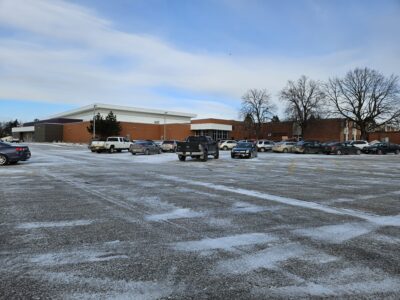
The new lab is across U.S. Highway 169 from the main campus, on land donated by Casey’s General Stores and the owners of the property where the Colonial Inn once sat.
The lab concept grew from a partnership between the college and Decker Truck Line Inc. based in Fort Dodge. The trucking company wanted to check the efficacy of biodiesel. The resulting test was called the Two Million Mile Haul.
Reynolds described it as “a groundbreaking study” that showed biodiesel was every bit as good as its petroleum based counterpart.
When the Two Million Mile Haul made the need for a testing lab apparent, college leaders began working with public and private entities to make that happen. Jim Kersten, the college’s former vice president for external relations and government affairs, was key in the effort.
Bond issue
The borrowing measure was approved in November by a 61.55 percent majority. A 60 percent majority was needed for passage.
“We’re just honored and we’re just humbled that the voters in the nine counties entrusted us with this money to create more plumbers, more HVAC workers, more dental hygienists and more nurses,” Ulrich said.
“We’re grateful,” he added.
The extension of the borrowing authority will not cause a property tax increase, college leaders have said.
Property taxpayers will continue to pay a levy of 33 cents per $1,000 of taxable value, a levy which has been in place since 2008.
The levy costs the owner of a typical Fort Dodge home about $2 a month or about $25 a year, according to the college.
The $35 million will be invested in buildings and equipment needed to train more people for high demand jobs in the area. Ulrich has said the college currently doesn’t have the physical capacity to train more people. The investments that are planned will alleviate that problem, he said.
A significant part of the money, about $18 million, will be spent to build a new Center for Ag Science on the Fort Dodge campus.
The center will house the agribusiness, ag science, animal science, precision agriculture and veterinary technician programs.
It will be located on the northeast side of the intersection of U.S. Highway 169 and Kenyon Road.
The Applied Science and Technology Building, one of the oldest buildings on the Fort Dodge campus, will be renovated to create more space for the dental hygiene, plumbing and heating, ventilation and air conditioning programs.
The college’s Webster City Center will get an updated heating, ventilation and air conditioning system. New windows and insulation will also be installed.
Bond issue money will also be spent to purchase new equipment for programs at all of the college’s centers and career academies at area high schools.
The first step in implementing the improvements to be paid for with the bond money will be completed this year. That step will involve construction that will not be paid for with bond issue money.
Ulrich said a new Center for Sports Performance will be built near the practice field on the south end of the campus near Kenyon Road. He said the building will house the football team and sports science classes.
It will be paid for with donations and money from housing, according to Ulrich.
He said construction will start this spring and be completed by the end of the year. Jensen Builders Ltd, of Fort Dodge, is the construction manager and general contractor for the job.
When the new building is complete, the football team will move out of the space it currently occupies in the Applied Science and Technology Building. Moving that team out will clear the way for bond issue-funded renovations in the building many people may know by its old name, Voc-Tech.
Other 2026 initiatives
A new restaurant, to be open to the general public, is expected to open on the Fort Dodge campus this fall. It will be operated by the college’s culinary arts students.
The restaurant will be in the northwest corner of the Hansen Center. Ulrich said it will be called Circle One, which is a reference to the college’s address of 1 Triton Circle.
It will replace the college’s Willow Ridge property on Madison Avenue northwest of Fort Dodge. Ulrich said the Willow Ridge property, which years ago was the American Legion Golf Course, will be sold.
Also this year, Ulrich will be lobbying the state legislature to permit community colleges to award baccalaureate degrees.
Those degrees would be awarded in a limited number of fields that are in high demand, specifically nursing, advanced manufacturing, accounting and education.
Ulrich said Fort Dodge is in a kind of “education desert” in which people have to go somewhere else or take classes online in order to get a bachelor’s degree. Those two options aren’t good ones for many students.
But offering a limited number of baccalaureate degrees, Iowa Central could support the local workforce and reduce the “brain drain” of people leaving the area, Ulrich said.
Progress 2026 Education
Music makes the school well-rounded
Scholarships for 2026 seniors are abundant
Even though we are in the dead of winter, it’s just a few short months before students will be done with the ...
Career Ag Academy now open for inspiration
Iowa Central Fuel Testing Lab debuts
Legacy Learning Boone River Valley awarded Arts & Culture Grant for ‘Sitting on Seneca: Finding Friends’
Creativity, connection, and a deep sense of place come together in the work of Legacy Learning Boone River Valley, ...