Trending
I'll admit it; I've been a bit "hooked" by the 2024 Olympic Games.
Maybe it started back in 1996, when our family went on a grand adventure to the '96 Atlanta Games. I still vividly remember being on the subway when the chaos in Centennial Park happened. Having to evacuate off the train car, in the dark, with three kids to account for, was not a highlight of our trip. Seeing Shaquille O'Neal and Mary Lou Retton standing next to each other was really "the long and short" of it. Now it's all "streaming" and the biggest game is hitting the remote button to avoid the advertising.
With the Olympics being held in France, there has been a lot of looking back 100 years to the 1924 Games, also held in Paris. It was a handful of years after the tumult of the First World War (which was known simply as The World War, since there hadn't yet been a second one). I was intrigued by the idea that, perhaps, one or more of the residents in Our Neighborhood may well have been in France around that time. My search of the newspaper archives for Hamilton County turned up more than a few who served in France during the War and now reside across the street.
I would like to write about two of them who were not fortunate athletes finishing their events to stand side by side on the medals podium.
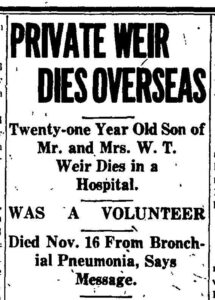
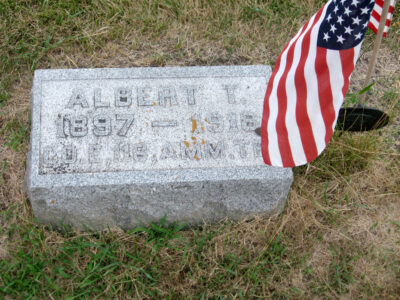
Albert Weir was born in May of 1897 about five miles south of Webster City. He enlisted in the Army and left in August of 1918 for training. By October 1, he was on his way to Europe as a member of an ammunition train unit. His brother, William, was serving in a stateside construction battalion for the fledgling aviation section of the Signal Corps (later the U.S. Air Force). By the time of the Armistice, six weeks later, Albert was already in an Army hospital in France, having contracted the dreaded Spanish flu (which actually originated here in the United States) shortly after his arrival. Albert died on November 16, five days after the fighting stopped. His remains were, eventually, returned to Webster City where he now resides in Our Neighborhood.
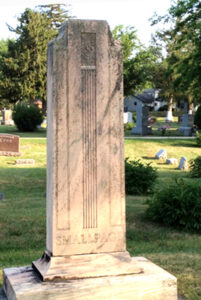
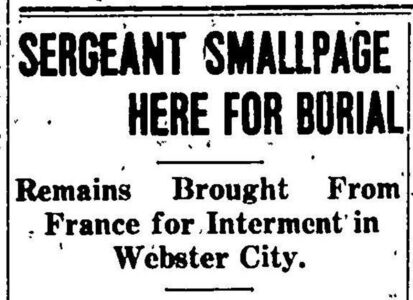
Melbourne Smallpage was born in Eagle Grove. While attending the University of Michigan he enlisted in May of 1917, being among the first to volunteer. He arrived in France in July of that year and advanced to the rank of sergeant during his time in service. In January of 1919, following the end of the fighting, Melbourne and several other members of his unit took a trip to Menton, Monte Carlo and Nice.
While on the furlough, Smallpage began to feel ill. Convincing his friends to bring him back to Dijon, where their unit was anticipating an imminent return to the United States, his health became worse. Upon reaching Dijon, he was admitted to the hospital and died a day or so later, also of the Spanish flu.
The United States military lost some 44,000 people to the Spanish flu in 1918-19. Smallpage's remains were also transported back here some time later and he, too, resides in Our Neighborhood.
I am going to continue watching the Olympics this weekend; I think it will be in a more subdued demeanor on my part. It humbles me to remember that we, the current inhabitants of this planet, owe so much for our enjoyment of things like the Olympic games to a multitude of men and women who gave their lives.
And I didn't even mention the second time we were "over there," some 20 years after Smallpage and Weir.
Our Neighborhood is a column by Michael Eckers focusing on the men and women whose presence populates Graceland Cemetery in Webster City.