
What to know as Iran and the US weigh holding a second round of nuclear talks
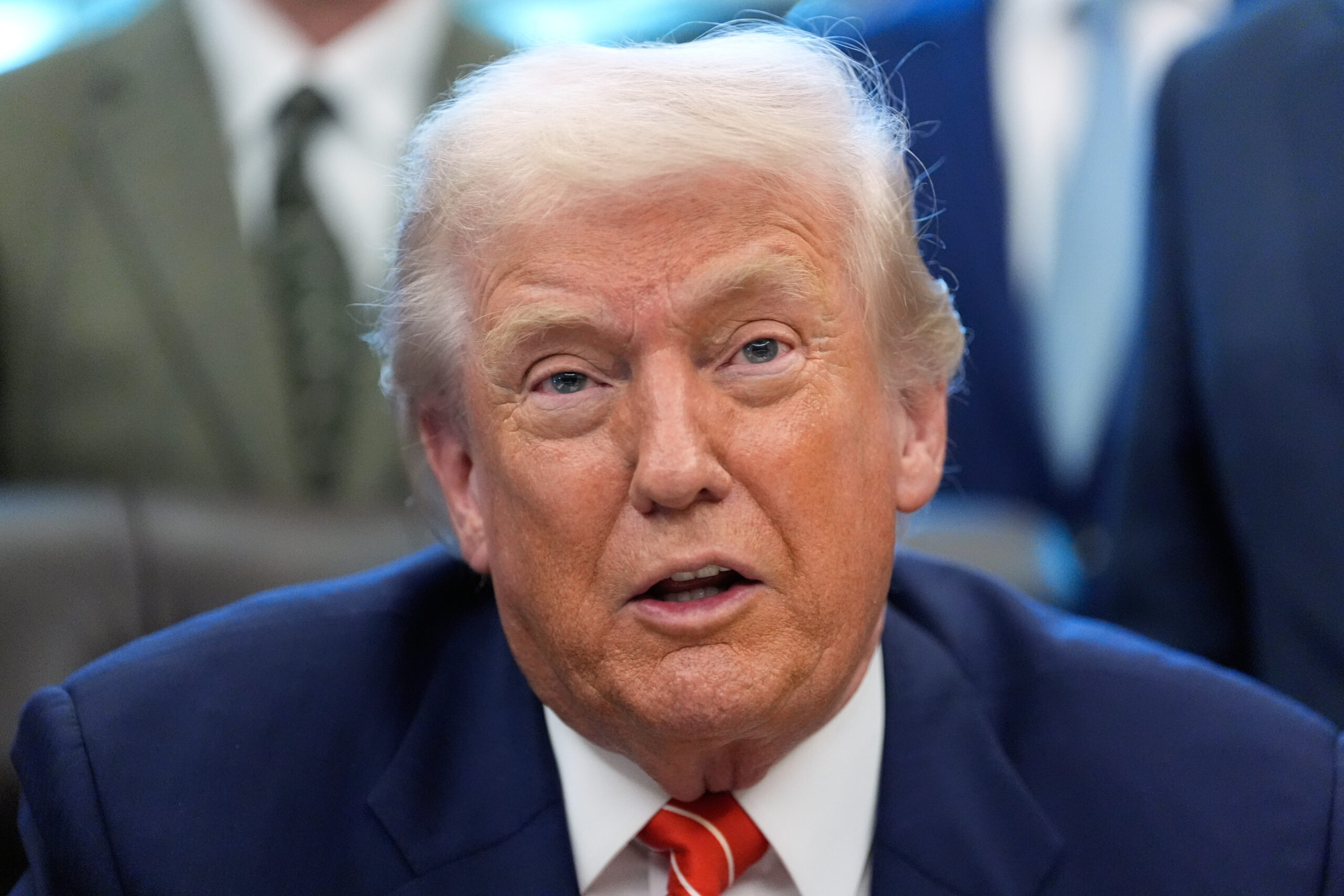
President Donald Trump speaks to reporters after signing a spending bill that ends a partial shutdown of the federal government in the Oval Office of the White House, Tuesday, Feb. 3, 2026, in Washington. (AP Photo/Alex Brandon)
By JON GAMBRELL Associated Press
DUBAI, United Arab Emirates (AP) — Iran and the United States are weighing holding a second round of talks over Tehran’s nuclear program after Israel launched a 12-day war on the country in June and the Islamic Republic carried out a bloody crackdown on nationwide protests.
U.S. President Donald Trump has kept up pressure on Iran, moving an aircraft carrier and other military assets to the Persian Gulf and suggesting the U.S. could attack Iran over the killing of peaceful demonstrators or if Tehran launches mass executions over the protests.
Trump has pushed Iran’s nuclear program back into the frame as well after the June war disrupted five rounds of talks held in Rome and Muscat, Oman, last year. Trump also has suggested sending a second carrier to the region.
A top Iranian security official, Ali Larijani, visited Oman this week and traveled onto Qatar, just after Trump called its ruling emir. It remains unclear how — or if — more talks will happen, though Mideast nations fear a collapse in diplomacy could spark a new regional war. U.S. concerns also have gone beyond Iran’s nuclear program to its ballistic missiles, support for proxy networks across the region and other issues.
Iran has said it wants talks to focus solely on the nuclear program. Iranian President Masoud Pezeshkian has insisted that his nation was “not seeking nuclear weapons. … and are ready for any kind of verification.” However, the United Nations’ nuclear watchdog — the International Atomic Energy Agency — has been unable for months to inspect and verify Iran’s nuclear stockpile.
Trump began the diplomacy initially by writing a letter last year to Iran’s 86-year-old Supreme Leader Ayatollah Ali Khamenei to jump start these talks. Khamenei has warned Iran would respond to any attack with an attack of its own, particularly as the theocracy he commands reels following the protests.
Here’s what to know about Iran’s nuclear program and the tensions that have stalked relations between Tehran and Washington since the 1979 Islamic Revolution.
Trump writes letter to Khamenei
Trump dispatched the letter to Khamenei on March 5, 2025, then gave a television interview the next day in which he acknowledged sending it. He said: “I’ve written them a letter saying, ‘I hope you’re going to negotiate because if we have to go in militarily, it’s going to be a terrible thing.'”
Since returning to the White House, the president has been pushing for talks while ratcheting up sanctions and suggesting a military strike by Israel or the U.S. could target Iranian nuclear sites.
A previous letter from Trump during his first term drew an angry retort from the supreme leader.
But Trump’s letters to North Korean leader Kim Jong Un in his first term led to face-to-face meetings, though no deals to limit Pyongyang’s atomic bombs and a missile program capable of reaching the continental U.S.
Oman mediated previous talks
Oman, a sultanate on the eastern edge of the Arabian Peninsula, has mediated talks between Araghchi and U.S. Mideast envoy Steve Witkoff. The two men have met face to face after indirect talks, a rare occurrence due to the decades of tensions between the countries.
It hasn’t been all smooth, however. Witkoff at one point made a television appearance in which he suggested 3.67% enrichment for Iran could be something the countries could agree on. But that’s exactly the terms set by the 2015 nuclear deal struck under former U.S. President Barack Obama, from which Trump unilaterally withdrew America. Witkoff, Trump and other American officials in the time since have maintained Iran can have no enrichment under any deal, something to which Tehran insists it won’t agree.
Those negotiations ended, however, with Israel launching the war in June on Iran. It hosted a new first round of talks on Feb. 6.
The 12-day war and nationwide protests
Israel launched what became a 12-day war on Iran in June that included the U.S. bombing Iranian nuclear sites. Iran later acknowledged in November that the attacks saw it halt all uranium enrichment in the country, though inspectors from the IAEA, the U.N. nuclear watchdog, have been unable to visit the bombed sites.
Half a year later, Iran saw protests that began in late December over the collapse of the country’s rial currency. Those demonstrations soon became nationwide, sparking Tehran to launch a bloody crackdown that killed thousands and saw tens of thousands detained by authorities.
Iran’s nuclear program worries the West
Iran has insisted for decades that its nuclear program is peaceful. However, its officials increasingly threaten to pursue a nuclear weapon. Iran now enriches uranium to near weapons-grade levels of 60%, the only country in the world without a nuclear weapons program to do so.
Under the original 2015 nuclear deal, Iran was allowed to enrich uranium up to 3.67% purity and to maintain a uranium stockpile of 300 kilograms (661 pounds). The last report by the IAEA on Iran’s program put its stockpile at some 9,870 kilograms (21,760 pounds), with a fraction of it enriched to 60%. The agency for months has been unable to assess Iran’s program, raising nonproliferation concerns.
U.S. intelligence agencies assess that Iran has yet to begin a weapons program, but has “undertaken activities that better position it to produce a nuclear device, if it chooses to do so.” Iranian officials have threatened to pursue the bomb.
Israel, a close American ally, believes Iran is pursuing a weapon. It wants to see the nuclear program scrapped, as well as a halt in its ballistic missile program and support for anti-Israel militant groups such as Hezbollah in Lebanon and Hamas.
Decades of tense relations between Iran and the US
Iran was once one of the U.S.’s top allies in the Mideast under Shah Mohammad Reza Pahlavi, who purchased American military weapons and allowed CIA technicians to run secret listening posts monitoring the neighboring Soviet Union. The CIA had fomented a 1953 coup that cemented the shah’s rule.
But in January 1979, the shah, fatally ill with cancer, fled Iran as mass demonstrations swelled against his rule. The Islamic Revolution followed, led by Grand Ayatollah Ruhollah Khomeini, and created Iran’s theocratic government.
Later that year, university students overran the U.S. Embassy in Tehran, seeking the shah’s extradition and sparking the 444-day hostage crisis that saw diplomatic relations between Iran and the U.S. severed. The Iran-Iraq war of the 1980s saw the U.S. back Saddam Hussein. The “Tanker War” during that conflict saw the U.S. launch a one-day assault that crippled Iran at sea, while the U.S. later shot down an Iranian commercial airliner that the U.S. military said it mistook for a warplane.
Iran and the U.S. have seesawed between enmity and grudging diplomacy in the years since, with relations peaking when Tehran made the 2015 nuclear deal with world powers. But Trump unilaterally withdrew the U.S. from the accord in 2018, sparking tensions in the Mideast that persist today.
___
The Associated Press receives support for nuclear security coverage from the Carnegie Corporation of New York and Outrider Foundation. The AP is solely responsible for all content.