
Martin University's abrupt closure in Indianapolis disrupts student plans, angers alumni
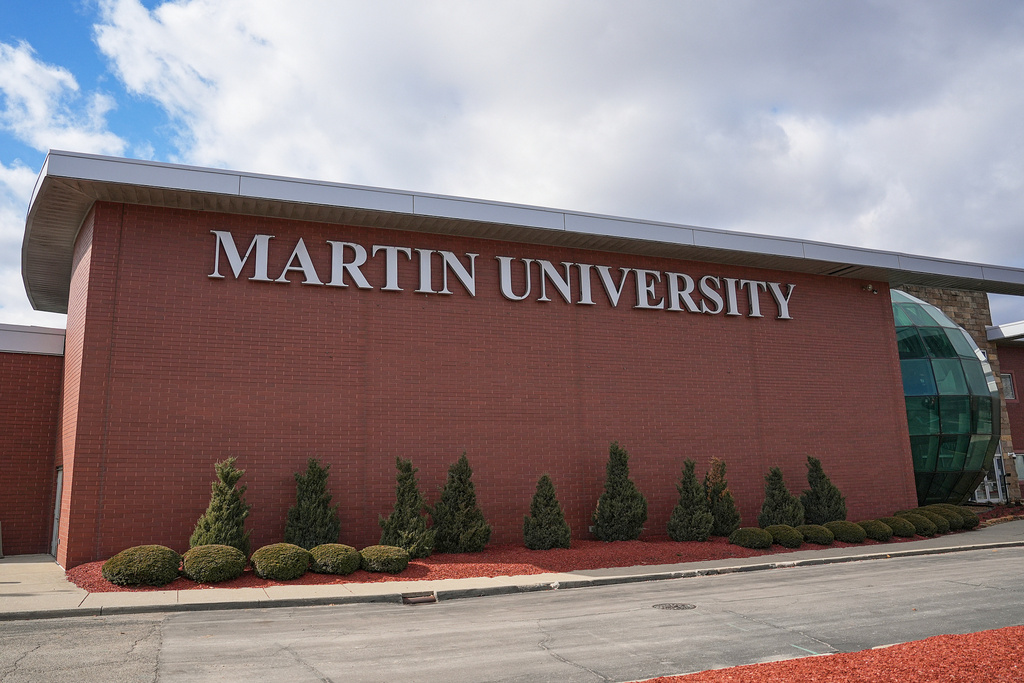
Martin University is seen, Feb. 15, 2024, on the east side of Indianapolis. (Jenna Watson/Mirror Indy via AP)
By CLAIRE RAFFORD/Mirror Indy Mirror Indy
Arneetrice Lane was determined to finish college this time.
She’d previously taken classes at Indiana Wesleyan University and Ivy Tech Community College, but didn’t graduate from either. Neither school felt right for her. But when she enrolled at Martin University, she felt right at home.
“You can express yourself without being judged or without feeling shunned for your opinion,” Lane, who is 34, said. “You can agree to disagree and still maintain positive relationships.”
This week, though, Lane’s plans were thrown into jeopardy when Martin University announced it would close at the end of the semester with no reopening date. The news came as a complete shock to Lane, who found out about the closure from a Facebook post before rushing to check her school email. She was on track to graduate in May 2027, but now, everything is up in the air.
“When I transferred to Martin, I promised myself that I would push through and I would finish no matter what’s still in my way,” she said. “It’s like, ‘What are you going to do now?’ It’s very disheartening.”
In interviews, three current students and three alumni of Martin University expressed hurt, frustration and confusion at the sudden decision. Current students, such as Lane, are weighing whether to transfer, and risk a new school not accepting their course credits, or to wait for when — or if — Martin restarts classes.
And for alumni, who’ve supported the university with their time and money, the news is nothing short of shocking.
“Nothing prepared us for this,” said Denell Howard, a pastor and vice president of Martin University’s alumni association.
How we got here
The move to close comes after a tumultuous year for Martin University. The eastside college is Indiana’s only predominantly Black institution. In the 2023-2024 school year, Martin enrolled 298 full and part-time students, according to federal enrollment data. About 84% of them were Black.
Earlier this year, community members rallied after Gov. Mike Braun did not include funding for Martin in his proposed budget. The private university got $5 million in one-time funding in 2023 from then-Gov. Eric Holcomb.
In response to community uproar, Braun met with community leaders and eventually visited the university, but state funding for Martin didn’t make it into the final budget.
Braun did not respond to Mirror Indy’s emailed request for comment in time for the publication of this story.
That state funding could have provided a lifeline to Martin, which cited financial reasons and enrollment concerns as the reason for so abruptly closing its doors. But Martin is a private college and does not typically receive state funding.
In an email Martin sent to students Dec. 8 that was obtained by Mirror Indy, the university said it would provide more information at a later date about classes and degree completion options.
“No final decision has been made regarding permanent closure,” a Q&A that accompanied the email read. “Discussions continue about how to carry forward Martin’s mission of serving underrepresented students.”
In an interview with Mirror Indy earlier this year, then-President Sean Huddleston acknowledged the financial challenges the school faced, but said its future “is as bright as it always has been.” Huddleston resigned from the school at the end of November.
“We aren’t necessarily competing with other institutions,” Huddleston said in February. “We’re competing with the lives of the students that we serve. We call ourselves a ‘communiversity,’ which means we’re in, of and for the community.”
Martin’s financial situation
This is not the first time that Martin has faced financial challenges.
In 2014, Martin was placed on probation by its accrediting agency, a group that examines colleges and ensures they are up to standard. Back then, that probation was due to financial problems and low student retention rates. It took Martin three years to get off probation.
Martin faces similar problems today. According to federal data, just 25% of full-time bachelor’s degree-seeking students who started at Martin in 2015 graduated within six or eight years — though many of Martin’s students are attending part-time. In contrast, the overall six-year graduation rate at U.S. colleges in 2020 was 64%.
And, from fall 2015 to 2023 — the most recently available data — enrollment dropped by 36%. Audits completed in June 2023 and 2024 showed doubt about the university’s ability to remain open for the next year, though both reports said the university and its board were optimistic about the university’s ability to sustain itself.
As of Jan. 3, the university had spent nearly $3.3 million of its $5 million state grant, according to invoices Mirror Indy obtained via public records request. Per the documents, Martin used the funding for everything from student recruitment events to facility improvements to funding staff and professor salaries.
In late February, Braun told reporters that the university had about $1.5 million left to spend on its grant, citing that as one of the reasons he elected not to advocate for the school to get more funding.
In the Q&A sent to students Monday, Dec. 8, the university said it was searching for solutions to help students complete degrees, including “partnerships with other institutions, teach-out agreements or transfer support.”
According to two former employees, including one who was involved in the conversations, Martin University and Marian University were in talks to partner at one point. Martin spokesperson Keona Williams said that all partnership conversations are confidential and “can not be discussed publicly.”
Marian did not respond to Mirror Indy’s request for comment in time for the publication of this story.
The university’s identity
For many Martin students, the school is not their first step on the road to higher education.
The school largely enrolls working adults, some who have attended at least one other college before coming to Martin. In fall 2023, nearly 80% of students at Martin were over the age of 25.
That was the case for Stephanie Groves, who graduated from Martin in 2002. She’d gone to IUPUI for a semester, but felt uncomfortable leaving her young child to attend class.
Without a college degree, she couldn’t advance at her company, even though her boss wanted to hire her for a program manager role.
That’s when she found Martin University in the late 1990s. From the moment she applied, Groves felt embraced and supported by the small community of Black administrators, professors and students.
“They love their city. They want people to learn. They want you to achieve,” she said. “So those kinds of people encouraged me to do better.”
Groves has stayed involved with Martin since her graduation over two decades ago, partially because she said she wanted to give back what the college had given her. When she heard about the closure, she didn’t believe it was real.
“My phone started just going crazy this morning, and I was like, ‘What’s going on? This is crazy,'” Groves said.
Martin University’s identity as a school run by and for Black people is also central to its students and alumni. The university was founded in 1977 by Rev. Boniface Hardin and Sister Jane Schilling specifically to serve minority, low-income and adult students.
For Howard, the Black pastor and alumni association vice president, the experience of learning from Black professors and students was one of his favorite parts of attending Martin. When he learned Martin planned to pause operations, he felt a mix of emotions — confusion, frustration and anger at what he saw as an unexpected decision from the board.
And while he fears what could be lost should the university close, he’s optimistic that the school will persevere — just like it has in the past.
“(Martin was) birthed for the success of the people who are marginalized, oppressed, pushed aside, overlooked, underserved, undervalued,” said Howard. “That’s what makes it great.”
What’s next for students?
For now, students are scrambling to figure out next steps.
Destiny Anthony, who was scheduled to graduate next fall with her bachelor’s in business administration, mourned the loss of the community she’d formed with her fellow classmates. She genuinely looked forward to class each week.
“It hurt, because it felt like something was dying,” Anthony, 23, said of the closure, “because that is the family we’ve created.”
When Anthony spoke to another college about transferring, she learned she’d have to stay in school for an extra year. So she’s thinking she might just bank on the college reopening soon.
“I am on the verge of just taking a break so that I can finish something that I am very comfortable with, that I don’t have any problem with doing,” she said.
But without an official timeline on when the university will reopen, some students may have to transfer in order to complete their degrees.
Lane had been commuting to class at Martin several times a week from Dayton, Ohio, where she got a new job in May. To her, the gas and long haul were worth it to finish her education.
Now, though, she’s not optimistic about how long it might take the university to reopen. So she’s planning to enroll at Central State University in Ohio, just east of Dayton.
Central State is an HBCU, and Lane liked that the school shared the same ethics and values as Martin. She’s sad about having to make this choice, but graduation is too important to her.
“I gotta push through and I gotta keep going,” she said.
___
This story was originally published by Mirror Indy and distributed through a partnership with The Associated Press.