
Midwest Fishing: Outdoor observations
Midwest Fishing
Trending
Yogi Berra is a baseball Hall of Famer who played for the New York Yankees. Mr. Berra is mostly known for his baseball skills, but his "Yogism's" are also part of his legacy. A "Yogism" is something that he said that sounds silly at first, but makes sense if you think about it for a bit. One of his most popular "Yogism's" is "You can observe a lot just by watching." Following are some observations related to fishing and the outdoors.
Lakes, rivers, and reservoirs have changed and are continuing to change. One very notable change in some areas, especially in lakes, is water clarity. In lakes where you could see the bottom in four feet of water, you can now see the bottom in ten feet of water. Many lakes are much clearer than they were just a few years ago. This is due in many places to the introduction of zebra mussels. "Zeeb's" are very prolific. One female can produce a million eggs a year. Zeebs eat algae, and as their population grows, the water clears up. Zeebs attach themselves to boats and boat trailers, which enables them to be introduced to different bodies of water when boaters travel from a Zeeb infested lake to another body of water.
The clearer water that many lakes contain changes the way we fish. Typically, the clearer the water, the spookier the fish. It will usually be more productive to fish in the deeper areas, and cloudy days or dawn and dusk will be when the bite is better.
Another change in the outdoors related to fishing is the introduction of different fish species. In some places, walleye populations have replaced the bullhead population. In other lakes smallmouth bass and yellow bass have become more abundant. Several factors explain this change in population dynamics, but changes in water quality are often primary reasons for the fish species changes.
Anglers report that fishing has stayed consistent in many places, but there are some lakes or reservoirs where anglers aren't catching as many fish as they did just a few years ago. Some believe that the catching is down because of increased fishing pressure. The good spots get pounded daily and the fish can become conditioned to lures. There is some proof that mature fish that become conditioned to lures can pass that conditioning on to their offspring. That could affect catching. And although catch and release is a big part of fishing for many anglers, there is concern about delayed mortality. That's when the fish is released, but dies a few days later due to injuries from being caught.
Last observation for now. Technology continues to change fishing. In the past several years, Forward Facing Sonar(FFS) has become a big player in how some anglers fish. FFS is revealing fish in places where we never thought to look for them. In the past, we usually looked for fish near underwater structures that were easy to
find with traditional sonar. Places like reefs, sunken islands, and weedlines were where we spent most of our time. FFS has revealed that good numbers of fish live in the basin of a lake away from structure. Some anglers don't cast until they locate a fish on their FFS. My experience with FFS is limited, but I still cast even if I don't know a fish is present. Old school is for me in a few ways. And I also still enjoy observing fishing things by watching fishing things.
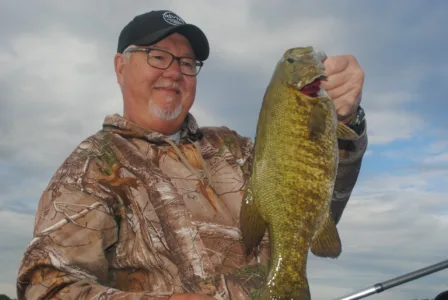
Photo Caption--Due to changing fish populations, Scott Soderquist is catching more smallmouth bass. Scott's okay with that.