
Ideas for ice-fishing success
Fishing the Midwest
Trending
In the northern regions of ice fishing country, anglers are starting to carefully venture onto the ice. In other areas, they're keeping a close watch on ice conditions, anxiously waiting for enough ice to safely walk on. Ice anglers, like open water anglers, are always anxious for the first trip out of the year to arrive. If you keep some of the following ideas in mind on first ice and through the ice fishing season, your chances for success will increase.
When fishing is slow, get as many lines in the water as possible. Be very sure that you know how many lines that you're permitted. Some states in the Midwest allow two lines, others more. Know how many you can have, then get that number down there.
When you're fishing from a shelter or a more stationary position, hold a rod in your hand, and have another line with a slip-bobber on it. Work the rod in your hand more aggressively with a spoon or a jig, and let the slip-bobber rod with just a hook or small jig and a minnow or wiggler on it work more passively. Let the fish show you the presentation they want.
Keep the bait above the fish. Fish can see up better than they can see down. If your bait is above them, they have a better chance of seeing it.
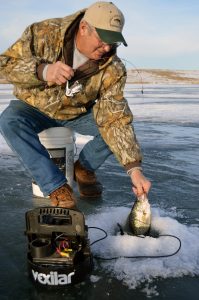
It works well to "pound" the bottom with your bait a couple of times to get the fish's attention, but when you see a fish on the sonar, get your bait a couple of feet above it. If it won't come up for the bait, lower it just a bit. Some of the sonar units that are available today do an outstanding job of showing fish and even the tiniest lures. Vexilar's newest introduction, the FLX30BB, does anything that an ice angler might want a sonar unit to do, but the old favorites like the 12 and 18 are also very user friendly and are huge ice fishing assists. Keep a close eye on your sonar and let it tell you where your lure should be in relation to the bottom and to the fish.
Try different lures. Fish get conditioned to lures that they see day after day. A lure that caught'em yesterday might not be productive today. When you see fish look at your lure but reject it, tie on something else. Swirl Drop Jigs and Drop Jig XL's have a unique appearance that imitates bugs and such in the water, and with the addition of a spike or waxworm, they smell and taste like something that a fish would eat. When the fish are active, tip your jig with plastic. It lasts longer and provides a different look.
When fishing pressured fish, less action on your bait is often better. But if a certain action on your lure has attracted the fish to your lure, keep imparting that action until they either eat or leave. If they eat it, that's a good thing. If they don't, that suggests that maybe we need to do something different to the bait. Maybe slow its action down once you have the fish's attention. Keep trying different things until you find what it is that they want. Give them a chance to eat the lure before you put a different action on it.
Hard-to-see line is usually better on finicky fish. Many anglers tie a short fluorocarbon leader to their main line because fluorocarbon is as close to invisible under the water as it gets. In fact, many very successful ice anglers have made the switch to fluorocarbon as their main line.
When it comes to fishing, there are no guarantees, but if you keep the above ideas in mind, you'll improve your odds for getting bit under the ice throughout the ice fishing season.