
City council accepts rail port study
Trending
On July 15, 2024, the City Council of Webster City received a $100,000 grant from the Iowa Department of Transportation, and approved $20,000 in local funding to study feasibility of building a rail port in Webster City. Rail ports are freight terminal facilities that ease the transfer of freight between trucks and railcars. The study was undertaken as an adjunct to certification of land in Gateway Industrial Park. At its October 5, 2026 meeting, Council accepted a report outlining findings of that study.
The study was completed by SRF Consulting Group, Minneapolis, assisted by Snyder & Associates, Ames. Its main conclusion was that although there is no immediate need for a rail port today, "Strategically, Webster City should view IEDA's recent certification [of industrial land] as required due diligence and a first step in having necessary pieces in place when opportunities arise. As a next step, Webster City should continue to work with Union Pacific . . . to gain visibility for Gateway Industrial Park as a U.P. Focus site."
Snyder is already working with Union Pacific on the next steps.
Mark Berndt, Project Director for SRF, was the author of the study's final report. He came to Webster City to explain findings of the study to the city council, and recommend next steps.
Berndt completed a detailed study of freight traffic in Hamilton County, using Freight Analysis Framework, a data base jointly-managed by the U.S. Bureau of Transportation Statistics, and Federal Highway Administration. It identified Mexico as the major export market for Hamilton County agriculture. Previous to 2025, Canada had been the county's biggest export market.
Other key findings of the study included:
•Hamilton County has 770 farms, and is one of Iowa's top agricultural producers
•The county "maintains a balanced mix of livestock and crops, with particularly strong outputs in hog and turkey production, and high-yielding crop land for corn and soybeans."
•The County ranks 6th among Iowa counties in corn production, and in the top 25 in soybeans.
•Union Pacific is "very interested" in pursuing a "focus site" in or near Webster City. Focus sites are pre-approved by the railroad for industrial development.
In response to supply chain shortages during the covid pandemic, the Iowa legislature enacted legislation to support small meat packers and lockers. Berndt said ownership changes and growth at Webster City's two meat processors, Mary Ann's Specialty Foods and Webster City Custom Meats, suggests demand may develop for cold storage and a rail port in Webster City.
Both of Webster City's meat plants are licensed by the U.S. government to handle poultry and red meat. This allows them to ship across state lines, and internationally. Since trucking can cost up to five times as much as rail, and, given the spike in diesel fuel costs, the two local meat packers could greatly reduce shipping costs if they could transfer refrigerated containers to rail at Webster City.
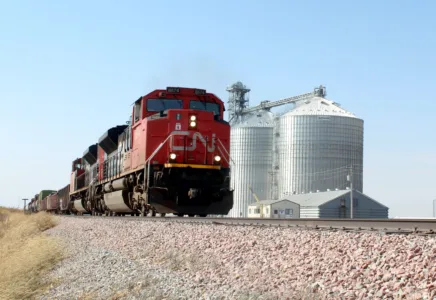
The study found all four sites recommended by the city for rail port development (three on Canadian National; one on U.P.) viable sites for a rail port, but the option in Gateway Industrial Park is the most affordable.
Berndt concluded, saying, "Webster City is fortunate to be served by two, class one railroads. That's rare for a city the size of Webster City."