
The day that Dolly came to town
Trending
Everybody's talkin' about Dolly.
Or so it seems. Whether you are a country music fan or a fan of Dolly Parton, no one can deny that Dolly Parton made a huge impact during her years on earth.
Ask just about anyone.
As a quiet family gathering honored her life on earth, on the pages of Facebook and other social media there have been questions about Dolly's visit to Webster City back 50 years ago.
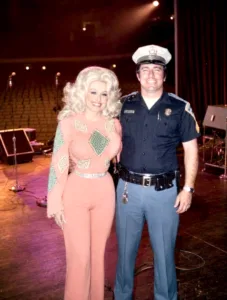
She came to town on April 30, 1976.
Bill Olson was the ICCC Center Director and Max Sylvester was the guidance counselor for the Webster City campus. Both were involved with the planning of this major fundraiser, and both still live in Webster City. I was attending Iowa Central and working for the Daily Freeman Journal at the time.
There was a committee that included Olson, Sylvester, G.D. Warland, Keith Maxon and Bill Babcock. According to Olson, Babcock had connections with agents due to his work on the Spotlight Series that was held each year in Webster City. The whole staff helped once it was set up, but the main work of arranging this production was in the hands of these five individuals.
This was the rising age of rock and roll, with hard rock starting to rear its head. There was some skepticism, according to Olson, about bringing a county music show to Webster City. Warland convinced everyone Dolly would be great.
"G.D. Warland said 'you won't miss if you can get Dolly," he said. He didn't remember the exact process or when it was completed. He said someone talked to Sylvester, and Babcock knew how to make the connections. Babcock had worked on the Spotlight series for Iowa Central, and even though this was not a Spotlight program, his experience made the difference.
"We worked through the system, got the agent, and got the contact," he said.
The contract for bringing Dolly Parton to Webster City was remarkable. Tickets sold for $4 in advance, $5 at the door.
"Her contract called for $5,000," said Bill Olson. "She put on two performances and we filled it twice." The college students, local businesses, and campus outlets sold 1600 tickets for each of the two shows, a full house. People from all over the midwest who came to Webster City to hear her sing.
"We were totally surprised by the turnout, we had two shows full," said Olson, " That was the big surprise. I don't think we realized what we had at hand, G.D. Warland was the one who knew how good she was."
"We turned the money we made into scholarships for students attending Iowa Central at the Webster City campus," said Olson. "We had tickets on sale all around Webster City. We hardly had any sales at the door, because everyone had advanced tickets. There were no reserved seats."
Everything seemed to go smoothly, no fighting over seats, no grumbling, according to Olson.
Their timing was perfect.
This was near the beginning of Dolly Parton’s rise to be the shooting star we now know. This was when she was completely focused on writing and performing country music. Parton was making headlines in Nashville, and the entire country was about to view her on television.
According to Maxi's column "Amblin along Mainstreet" on January 28, 1976, after booking Dolly to perform in the Washington Central Gym, he received a visit. He wrote:
"Bill Babcock showed us a copy of an article, 'Dolly – Another First for Television' which appeared in the Tennessean newspaper.
The feature states that Dolly will become the first woman to host a country music television series next fall, sharing the opening spotlight with a shimmering, spangled butterfly that has become the symbol of her song she wrote and recorded, "Love is Like a Butterfly."
The show will simply be called "Dolly" and will be a half-hour musical variety show aimed at displaying the musical talents of Miss Parton and the "total Nashville scene. Dolly Parton has been voted the top female vocalist in country western music in 1976-1976."
At that point other artists might have renegotiated their contract, but Dolly Parton was good to her word, and met her obligation to the college here with the grace and smile we all understand now.
Those who attended either of the two performances received an hour and a half of Dolly singing her heart out to the people here in Webster City.
Dolly was joined by her Traveling Family band, which included Dolly's brother, Randy, playing bass guitar, Dwight Puckett, who played drums, Tom Rutledge who was lead guitarist and fiddle player, Richard Dennison, at the piano, Joe McGuffee, steel guitarist and Bill Rehig of Kutstown, Pa., who played lead guitar, fiddle and doubled as her road manager.
The traveling family band was formed in the latter months of 1974 and appeared with Dolly at the Wembley Festival of Country Music in Long in 1975. They also appeared with her at the Grand Ole Opry and on her TV show. Three other family members originally were expected to perform as a trio. In the end, they didn't come to Webster City. The night was all about Dolly.
"We built a walkway out of straw and hay, and she made a joke that she was allergic to hay," Olson remembered, "Right away, they just loved her." Her stage was in the very center of the Washington Central Gym, where her band backed her up, giving her the ability to perform to every person in the room.
Students from the college helped by selling tickets throughout Webster City in addition to helping the night of the show.
"We had young ladies dressed in country garb that served as usherettes," Olson said.
Billy Cole, Country Music Association disc jockey of the year, was the emcee of the program. Famous in his own right, he didn't hold a candle to Dolly. She was the show.
Dolly gave a brief interview during intermission before she left town for shows in Wisconsin, Canada and Hawaii. As quoted from the May 3, 1976 paper, "Dolly expressed her delight in being in Webster City. She added, "Webster City is a fine community to me, and I always feel welcome where I go."
Those in the room interviewing Dolly included Cindy Kaulen from the Daily Freeman Journal. But the questions were handled by larger media representatives, with the Des Moines Register and other media controlling the interview. As she passed along her notes to Maxi, she reflected.
"Dolly left the impression of a person not affected by success. She was warm and human, something that one doesn't see in many successful stars today."
Olson did not get to meet Dolly. He was certain that Bill Babcock had a chance to meet her personally and a few who stayed to get her autograph, something they were told she would not be able to do..
"I don't know of anyone else who met her, I did not get to meet her." said Olson. At the time, he remembered being very busy with handling the logistics, and she was very busy getting ready and resting for the performance. But he was truly impressed with the show.
"I was busy, she was busy, I don't think she missed me," he joked, "She was very talented.
"Bill Babcock knew how to get hold of agents for this type of performance," said Olson. "He was here to greet them, he was the backbone of setting this up."
There were two performances; at 7 p.m. and 9:30 and the stage was designed in the center of the Washington Central Gym to allow every member of the audience a good view. Nearly 3200 attended the two concerts.
Dolly had performed at the Iowa State Fair on August 27, 1970 on the Grandstand, but she was just one, along with Porter Wagoner, Faron Young and the Deputies.
The Webster City stage in 1976 was her first solo performance in Iowa. According to the Internet and AI, it was the State Fair visit during the following year in 1977, with her band that was then named Gypsy Fever. Webster City was the first.
Olson was sure the fair paid her more.
"She told stories about living in a one room cabin, where she started and where she ended," he remembered, "She took care of her family."
That was evidenced over the year by the many family members incorporated into her business, from playing in the band, singing with her, and working to keep her safe.
In 2026, tickets to a Dolly Parton show in Las Vegas started at a price of nearly $500, with prices for the best seats through Ticketmaster we sold for $2300. When on tour, they were more reasonable, with prices starting below slightly below $100 on up.
So the team who put on that show offered an experience of a lifetime to the farm families, students, teachers and other workers in Webster City. They may have gotten the deal of a lifetime attending this concert.
"We got her at a bargain basement price, she became so famous after that," said Olson, " It might be because we were a college."
But the college was raising money for the kids.
They were raising money for scholarships for students in Webster City. A small town, a farming community. With simple roots.
That might have had something to do with it.