
It’s back to school and the buses are here
The first day of school in Webster City ends with calm supportive smiles
 Kolleen Taylor
 Trending
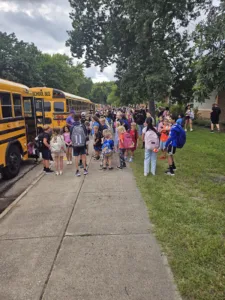
The first day of school brings many things, including new teachers, new classrooms, new friends, new school supplies and clothing. But it also brings the return of the bus scramble, the return of children on bicycles, walking on sidewalks and learning how to navigate the transportation needed to get to and from school.
For older students attending the Webster City Schools, the bus scramble is easy to navigate. But for the little ones, those who are experiencing the bus scramble for the very first time, it's a challenge to navigate.
And sometimes it’s a challenge for the older students too.
Ted Larson, the Webster City Community School Director of Transportation, was at the bus scramble on Elm Street on the first day of school to ensure everything goes as it should. Larson started working for the Webster City Community Schools as a wrestling coach. But he has now been directing the bus operations for 20 years.
There were a few hiccups, children who needed assistance locating their bus.
"This is the first day," he said, "Give us three or four days, and then it will be flawless."
"We are transporting 720ish students twice a day," he explained. "That is pre-school through seniors, we transport for 3 or 4 preschool locations too. There are two classes at Asbury, a class at Northeast, a class at Riverview and a class at St. Thomas."
School buses don't just run for the country kids.
"I've probably got roughly 100 students that are rural," Larson said, "Each bus has a rural route, then they pick up kids at 5-8 bus stops along the way into the scramble."
"This doesn't even count the 1600 extra events that our vehicles transport," he said. "Theres a lot that goes in and out of this bus barn."
The bus scramble began in September 1968 as an experiment, with Superintendent Robert Horsfall presenting the idea to the school board and city council. It was tested for 30 days before determining if it was successful.
Prior to 1968, according to Horsfall at the time, the buses would go to as many as six of the schools within the city. When it was proposed for the 1968 school year, it was hoped that they could reduce the amount of time at the various schools. It was hoped to reduce the number of miles on each bus. And at that time, the primary students who could not read would pick their right bus by figures of Snoopy, Superman, Lynx and other figures denoting those buses going to a specific building.
The numbers have not changed much over the years. In 1968, approximately 725 students were bussed on 17 regular routes, with 1 special education route and 4 noon kindergarten routes.
"This operation is one that has many inherent problems of routing, time schedules, proper load limits, supervision and the like," Supt. Horsfall said in an interview done in 1968.
Looking back, it must have gone pretty well most of the time. Nearly 60 years later, the same procedure is being conducted throughout Webster City. Most of the schools in the state have some type of similar system, some call it a union, some a hub, said Larson. They all do the same thing, they streamline the transportation of the children attending school.
And in Webster City, the caring concern was evidenced in all the teachers and other staff assisting. Deb Dunham, Lyn Ehrenberg and Kayleigh Greufe were among the WCCS personnel helping children to their correct buses. Susan Davenport provided language assistance for some of the children and parents to identify the students who missed their connections.
Larson was actively involved assisting students to their correct buses, assisting teachers and other school personnel in getting confused children to the proper place. Once the last bus departed, there were a few who needed a trip home. He drove the last remaining students to their proper destination.
On the first day of school, it's to be expected. Larson helped get them to where they needed to be, driving a smaller bus, the children and the staff were all calm, so even the youngest child patiently waited while the adults figured out what had happened.
"I had six today," he said, "We don't ever lose them, it might take a minute or two, but we always find them."
Sometimes students make new friends and just want to go home with them, explained Larson, and sometimes they are just talking and forget to get off the bus.
This obviously was determined a success 58 years ago, as the same process has delivered students to the proper schools and proper homes since the 1960's.
"It's been handled by many caring, qualified people," Larson said, "It's not just the bus barn superintendent, our principals, teachers and staff are carrying the weight of all this."
"This system works very, very well, but it takes all of us, it's a team effort," he said, "Because parents in this district; they put their pride and joy on a bus and they trust us to get them home."
Larson said today, the school buses are more important than ever, as both parents are often working and can't stop to take their children to school.
"Every one of my drivers takes so much pride in what they do," he said. "The bus drivers, they are the first ones to represent our district and the last one they see at the end of the day."
"It takes a special person to drive a school bus."