
ISU President David Cook says helping Webster City plan its future is land grant mission in action
Mayor’s Design Workshop brings focus to Webster City
Trending
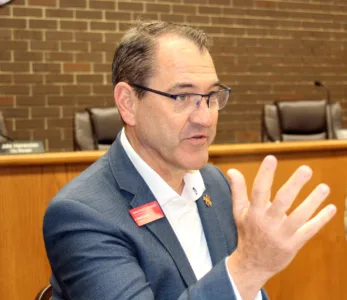
Dr. David Cook, the 17th President of Iowa State University came to Webster City yesterday on a mission to explore and investigate the work done by the ISU students for the Mayor's Design Workshop, which was presented to the community in May.
"We [ISU] were built to care deeply about our state. It's projects like this that put our land grant mission into practice," he said.
Since being appointed last March, Dr. Cook has made a major priority of meeting university faculty, staff and students. Referring to what he terms ISU's "99-county campus," he's traveled across the state, tying together the visits with programs and projects at ISU. His stop in Webster City, was one of those visits. Cook said he's made such trips "a priority, a chance to get out, listen and learn across Iowa."
Webster City was one of six Iowa cities selected to participate in the design workshop which was a year-long symposium that brought together faculty and students from the University's architecture, engineering, and landscape colleges, to work on challenges facing small cities. Recounting his experience at the workshop, Webster City Mayor John Hawkins said, "I encouraged them to give us everything they had, and they did."
The Assistant Professor of Landscape Architecture, Austin Dunn, who was one of the faculty leaders of the workshop, reviewed the work yesterday with Cook and other Webster City Community leaders at a meeting held at the Webster City Council Chambers. He explained the work of each of the five teams to the group assembled, including President Cook.
He referred to Brewer Creek as "a real gem of Webster City," stressing much more could be done to maximize its effect on the city. "We looked at the entire 25 square mile watershed of the creek, and saw multiple places where the streambed can be restored, and erosion of the banks controlled," he said.
Dunn explained that one of the teams submitted the concept of a new residential neighborhood "with Brewer Creek and its trail as the focus rather than just city streets."
The focus wasn't just as a recreation area, the concept addresses a real concern for the city.
"New housing is an identified need in Webster City, and the location we suggested [along Brewer Creek west of Beach Street] is identified in the city's comprehensive plan for housing," he commented.
He called the approximate one-mile distance between the Brewer Creek Trail at Des Moines St. and the Boone River Trail at East Ohio Street, as "a critical gap in your trail system that, if closed, would make both trails part of the same network." Another idea his students suggested, was the creation of "an outdoor classroom of nature" along Brewer Creek, at the extreme south end of the school grounds.
City Councilman John Marvel said "the knowledge and enthusiasm of the students who worked on these concepts just blew me away." He was especially praise-worthy of ideas for the Gateway Industrial Park.
"When I told them we were building a truck stop near the center (ie. the Brew Oil development), they immediately came up with several new ideas. One, is construction of a bed & breakfast, or country inn," Marvel said.
Readers might not associate a B&B with an industrial park, but as Prof. Dunn noted, Webster City did not have to include only industrial sites in the Gateway Industrial Park.
"In the industrial park, our goal was to evolve a design that could only happen in Webster City," said Dunn. He further stated that it can become a community asset beyond providing employment and tax revenues.
Another concept for the industrial park was the idea of a brewery with outdoor seating and sweeping view of the countryside. City Information Director Amelia Oliver referred to the brewery, and places like it, as "a third space," a place other than home or work, where people gather to socialize. Such amenities add to the quality-of-life of the city, and would provide every-day amenities for those employed at Gateway.
The work put into the project started with two day-long meetings in July, 2025, which defined projects that the students worked on throughout the remainder of the academic year.
In May, those five teams of students showcased their work at Fuller Hall, where city officials, staff and interested citizens viewed "big picture" concepts, capable of determining how the city looks and works for 50 years into the future.
Four of the five teams focused their work on Brewer Creek; its water quality, flood control, trails, and how the creek and trail might influence new housing development. A fifth project proposed designs for Webster City's newly-enlarged Gateway Industrial Park. It added up to design concepts that "allowed us to explore ideas we might otherwise have considered," according to City Manager John Harrenstein.
With the visit from Dr. Cook to Webster City yesterday, these ideas and dreams created by these students took on another role; they were able to place the concepts in front of not only the leaders of our community, but the leadership of Iowa State University. The value and vision focused on by Dr. Cook's visit again places Webster City in an enviable position around the state.
These concepts, even if not possible to implement easily, help give direction and focus to our current leadership, and help create a stronger future for not only our existing residents, but future leaders and business people in Webster City.