
Webster City and Hamilton County responded with great patriotism as the Civil War began
Trending
When Abraham Lincoln was elected president of the United States on March 4, 1861, many of the southern states had already passed the Ordinance of Secession.
When Lincoln issued his proclamation calling for 75,000 troops, the country was full of patriotism. That patriotism extended beyond the Mississippi to Iowa.
In Webster City, there was a public meeting called where a "Liberty Pole" was raised. Speeches were made by Judge Porter, Peter Hepburn, John A. Hull, Granville Burkley, John F. Duncombe, Jacob Skinner and many others pronouncing their patriotism. Those same men had been divided just five months earlier, but now that the country was in danger, they worked as brothers, determined to eliminate treason.
In a neighboring county the Republican and Democratic flags were taken down, spliced together and raised again, signifying the unity of the two political parties, according to an account from J.W. Lee.
Hamilton county residents were in agreement to support the effort, and in June, 1861, the Hamilton County board of supervisors appropriated $1,000 to be used in expenses of volunteers and caring for families of all who enlisted.
During the war, 163 soldiers enlisted from Hamilton county. Of those who enlisted, 34 died while in service.
After the war ended, there were many veterans of the Civil War who relocated to Iowa and the Webster City area. These men held reunions periodically, the photo of one such event was in last weeks Freeman Journal. In that photo, seated on the end is Shiloh.
Shiloh was reported to have arrived in Webster City in 1867. Claiming he had served as a drummer in the War between the states, he came into the community playing his drums and woke the neighborhood. Those who went out to investigate saw a boy in rags, who told them "They told me to play my drums. I am the drummer boy of Shiloh."
Although some questioned that he might have been too young to be at the Battle of Shiloh is, it has been learned since then that drummer boys were normally between 12 and 16 years of age during the Civil War, but some were as young as 9 or 10 years of age.
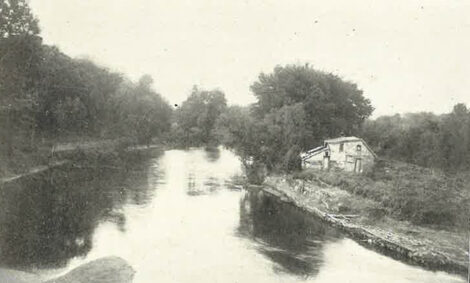
Shiloh built himself a shack on an island about 50 yards south of the Dubuque Street Bridge, now known as Bank Street bridge. When the Catholic Church was demolished in 1900, scrap building materials were collected to add to Shiloh's cabin.
Shiloh was considered a recluse, however he was a fisherman, storyteller, and was known for his wandering around the town searching for anything discarded by residents. The community came to trust him, are helped provide for him, intentionally providing clothing, setting out good food and helping him throughout his life.
McKinlay Kantor, who wrote about the Civil War, met Shiloh when he was very young and was intrigued by Shiloh's stories about the Civil War. When Shiloh died on December 7, 1913, Kantor asked his mother to take him to the graveside service, where he was buried in an unmarked grave. That grave is now marked in the Graceland Cemetery, a task that was completed in 1976.
It was during the Civil war that more changes in the organization of Hamilton County occurred. The township of Grove was created, the area west of Cass township. Later the board changed the name to Fremont, in a show of union support; but they also changed the names of these townships: Clear Lake to Lyon, Wall Lake to Ellsworth and Norway to Scott.
The county supervisors began to levy taxes to support the schools, and county operations.
Since most of the civil war occurred far from the Iowa borders, those who did not enlist were somewhat ignorant as to the operations except through family and friends who had been able to write and update them about the trappings of this war.
Those who did not survive the war, and those who died upon returning to their homes in Webster City had markers placed upon their graves, identifying their service in the Civil War. Those can still be seen in the cemeteries in Hamilton County today.