Wilson Brewer plats Newcastle, later renamed Webster City
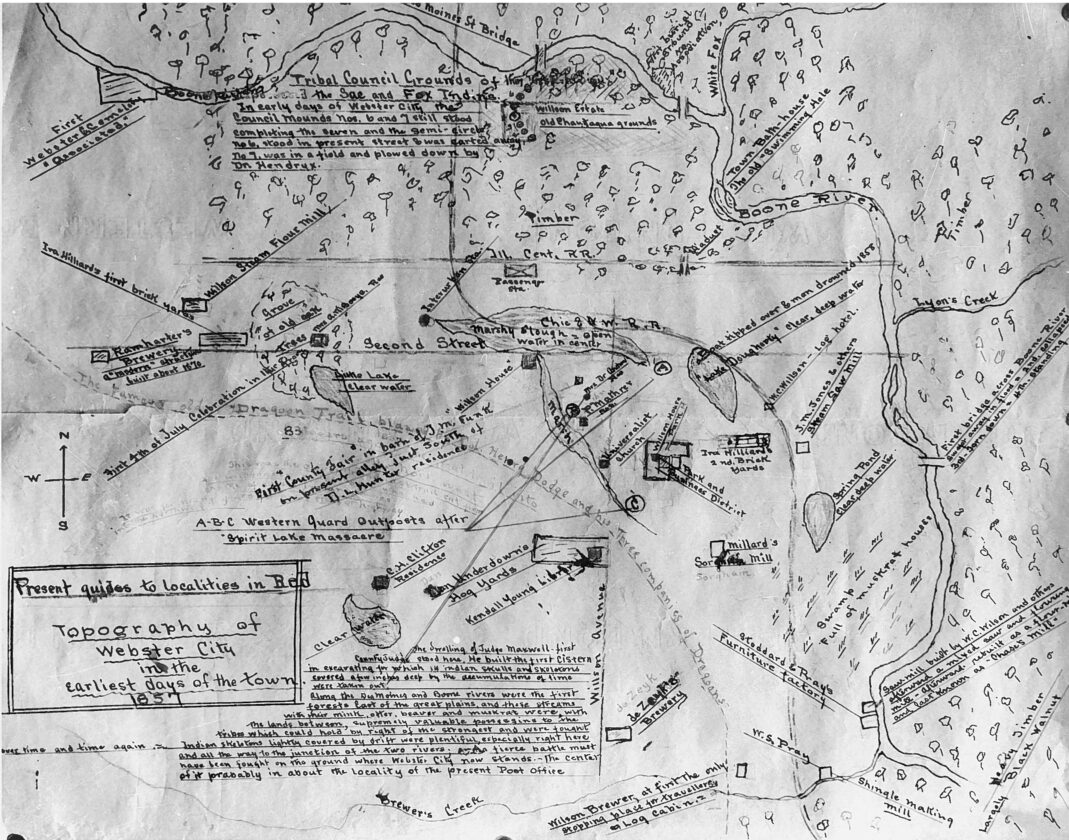
This early map, dated 1857, shows where current landmarks are in relation to settlement areas of the community. (Map courtesy of Jane Curtis)
When the founding fathers in the east coast were working on the Constitution for the United States, Webster City nor Iowa were in their vision. At that point exploration beyond the thirteen colonies were very limited.
The area known as Webster City and Hamilton County at that time had indian settlements along the river. In 1776, there were no established communities, it wasn’t until 1833 that the plains of Iowa were opened for settlement. Iowa became a state in 1846.
The Boone River continued to play an important role in the history and development of the area. In early June 1853, three companies of U.S. Dragoons, commanded by Col. Kearney were on an expedition to survey and explore the East Fork of the Des Moines River. They camped two miles east of the mouth of the East Fork and renamed it in honor of Capt. Nathaniel Boone, son of the famous Daniel Boone.
They continued marching northeast and on June 21, 1853, they camped at what was later to become the hog lot of Dan Underdown, proprietor of the Willson House and county sheriff. It is now the site of the Kendall Young Library, and a stone marker on the northeast corner commemorates this site. They stopped overnight along a small lake in an oak grove.
Wilson Brewer was the first settler of Webster City. He came up the river to the Bone’s Mill site, which he called Hope Hollow in 1852. He traveled up the Boone until he came to a horseshoe bend in the river. He built a cabin along Brewer Creek where the present family burial plot is located and named the settlement Newcastle. The Wilson Brewer Park is named for him, donated to the city in the 1930’s, establishing this as a memorial to the Brewer family.
Newcastle was platted on Oct. 27 1854 by Wilson Brewer and William Frakes. The plat had four streets; two blocks wide and four blocks long. They were named First, Second, Third and Fourth Street; and the only north-south street was called Main Street. Today that street is now called Union Street.
On June 29, 1857 the first newspaper was established as the Hamilton-Freeman by Charles Aldrich as a nod to the support of freeing the slaves in the south.
Local News
Wilson Brewer plats Newcastle, later renamed Webster City
America at 250: A journey through time, told through our communities
What began as an experiment in self-governance rooted in personal freedom and liberty has grown into the world’s ...

Addams Family opens tonight
Community-wide garage sales return Memorial Day weekend
As warmer weather arrives and spring cleaning gets underway, it’s time to start planning for one of Webster ...

Congregational Church annual thrift sale next weekend, spring cleaning lead up to city-wide garage sales