A small piece of local history comes home to Webster City
103-year old reminder of our retail past
-
-
Daily Freeman-Journal photo by Robert E. Oliver
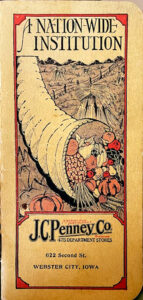
This is a photo of the advertising calendar that was sent to the Webster City Area Chamber of Commerce for 1923/1924. There was a J.C. Penney store in downtown Webster City until 1986.
Daily Freeman-Journal photo by Robert E. Oliver
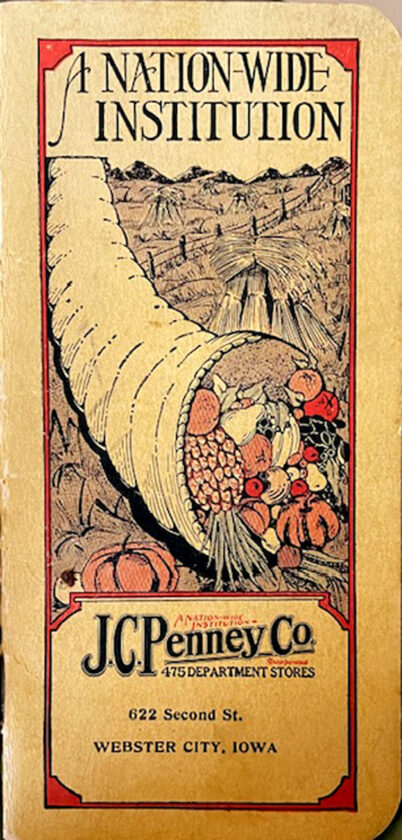
This is a photo of the advertising calendar that was sent to the Webster City Area Chamber of Commerce for 1923/1924. There was a J.C. Penney store in downtown Webster City until 1986.
Earlier this week a small envelope arrived at the Webster City Area Chamber of Commerce. It contained a pocket-sized memo pad with a 1923/1924 calendar, and this note;
“We are antique dealers and downsizing our inventory. I found this booklet from J.C. Penney in Webster City. It’s in such good shape, I hated to throw it away.” It is signed by Uni Kischer of W. Des Moines.
The 103-year old artifact, an inexpensive giveaway used as what was once called “reminder advertising,” has the address of 622 Second St., which many will remember as home to the former Olson Pharmacy, owned by Dean and Lucy Olson. In 1923, however, the building housed J.C. Penney Company, which promoted itself in that now-distant year as “the largest chain of department stores in the world, operating in 475 cities and towns in 33 states.”
The very essence of a middle market department store, J.C. Penney relied on house brands to ensure good value for its price-conscious customers. Generations of Webster Citians went there to buy Big Mac work clothes, Brentwood dresses, Towncraft underwear, Penn-Prest dress shirts, and Sterling overcoats and jackets, all brands sold exclusively at Penney’s.
James Cash Penney (yes, that really was his name) opened his first store in 1902 in Kemmerer, Wyoming. Named “The Golden Rule Store,” it was a reference to the Biblical golden rule, “Do to others whatever you would have them do to you,” from Matthew 7:12. As the company grew it had a legal need to incorporate, and when it did so, its name officially became J.C. Penney Company. The Golden Rule name was last used in 1913. Regardless, Penney still used the Biblical reference as what today we would call its “mission statement.”
Penney’s was always different from its competitors Sears, Montgomery Wards, Spiegel’s and Alden’s, all Chicago-based cataloguers. Penney was headquartered at 570 Seventh Avenue in New York City, adjacent to Times Square. Its first catalogue wasn’t published until 1963.
Other stores had employees, Penney’s preferred to refer to its staff as “associates.”
As business at its Webster City store grew, Penney’s moved across Second Street to 619, the site of Sports World today. The company spent an undisclosed sum to modernize the store along the lines of corporate directives before moving in. When Penney’s Midwest Regional Office in Schaumberg, Illinois announced the Webster City store would close July 19, 1986, the Chamber of Commerce, other Second Street businesses, Penney’s employees and ordinary citizens mounted a letter-writing campaign to convince the company to reverse its decision.
The argument cited for keeping the store open was the announcement by Webster City Products Company that it had been acquired by A.B. Electrolux of Stockholm, Sweden, and was planning a nearly $90,000,000 expansion of the local factory. The city’s population was set to grow, and that would almost surely have meant more business for Penney’s, and all downtown merchants.
The reality was that by 1986, the Penney’s store, although drawing customers from several adjacent counties, was just breaking-even, a victim of the devastating “farm crisis” that hit Central Iowa hard.
The memo pad will be offered to the Depot Museum at Wilson Brewer Park. Before any artifact can be accepted by the museum, it must be reviewed by the park’s Foundation Board.
If they feel it merits addition to the collection, the item goes through a formal accession process, at which time it officially becomes the museum’s property.
Local News
New Fiction and non-fiction books available for check-out at Kendall Young Library
The Kendall Young Library has received the following new fiction books that are now available to be checked out of ...
A small piece of local history comes home to Webster City
A Taste of Italy
The Blanden Memorial Art Museum presents “Cityscapes,” a watercolor exhibition by Fort Dodge native Richard ...
2026 Iowa Crop Production costs increase, limiting profit opportunities for corn and soybean farmers
AMES—Iowa corn and soybean producers continue to face tight margins heading into the 2026 growing season, ...
Kendall Young Book Clubs meet next week
Kendall Young library offers three different adult book clubs in early February. There are multiple copies of each ...