Grants help upgrade Kamrar Fire & Rescue Readiness
-
-
Submitted photo
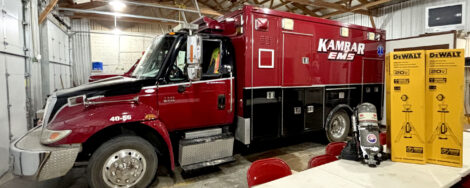
The new Kamrar EMS ambulance looks smart with a new paint job in the city colors. This was acquired in July to replace an older unit. In the foreground are new tripod lights and replacement air tanks for SC breathing apparatus kits, both of which make a fire or emergency site safer for volunteer firefighters and EMS technicians.
Submitted photo
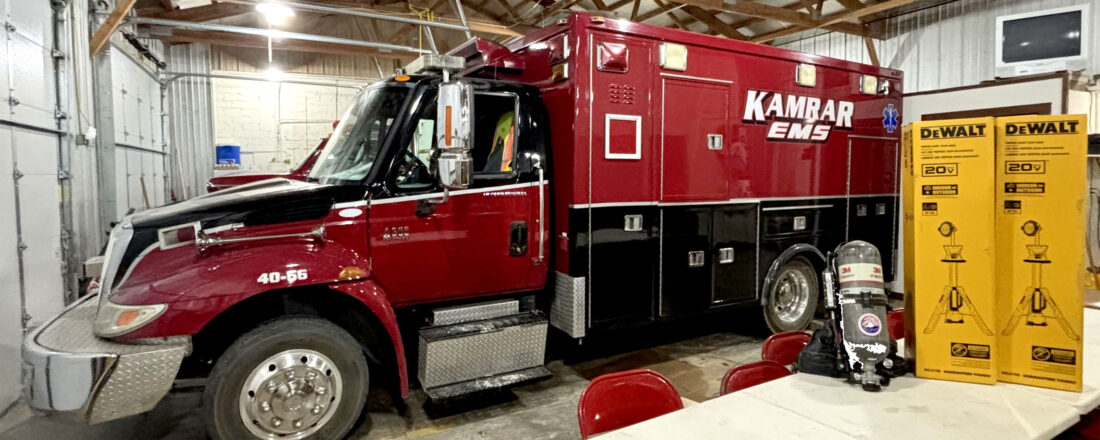
The new Kamrar EMS ambulance looks smart with a new paint job in the city colors. This was acquired in July to replace an older unit. In the foreground are new tripod lights and replacement air tanks for SC breathing apparatus kits, both of which make a fire or emergency
site safer for volunteer firefighters and EMS technicians.
Homeowners and farmers in the Kamrar area, can breathe a little easier this winter, as important emergency equipment is now available at Kamrar Fire & Rescue, making it seem a little like a gift at Christmas time.
They needed upgraded equipment for the protection of their fire fighters. Thanks to two grants, they have been delivered.
It was a critical need. Should a major fire or disaster occur, Kamrar, population 192, would rely on assistance from larger departments in Webster City, Fort Dodge and Iowa Falls.
Like many rural towns it appreciates the value of having its own basic fire and rescue equipment and supplies in town is essential. This speeds up the critical response time for its 15 volunteer firefighters. Since its founding in 1933, they have steadily improved its equipment, supplies and personnel training.
A new Basic Life Support ambulance can easily cost over $200,000 today. That’s a serious burden for a small city with few taxpayers. For Kamrar, whose ambulance was due for replacement, an ideal solution emerged last July: a well-maintained used ambulance, formerly in service in Alden, came on the market.
“We needed to replace outdated equipment, so I wrote grants to help replace those items. Kamrar Fire & Rescue has a limited financial budget due to being a small rural department,” said Ryan Rupiper, a volunteer in the Kamrar Fire Department in a press release.
Two of those grants came through.
The first, given by Williams-based Agro-Liquid, provided $1,340 that enabled purchase of two portable, tripod, emergency lights to improve safety at fire or rescue scenes, as well as 6 pairs of rescue extrication gloves. The gloves protect firefighters from chemical or fuel burns, and blood-borne pathogen exposure.
Agro-Liquid makes and sells liquid fertilizers across Mid-America from Minnesota to Louisiana. It operates formulating, warehousing and shipping facilities in Williams.
The second grant, a $7,000 award from Enhance Hamilton County Foundation, bought four new self-contained breathing apparatus sets, four masks, and four 45-minute air supply bottles.
Air near fires or chemical spills is often toxic, so protection and a source of safe oxygen is essential to firefighter safety and effectiveness. The new equipment is compatible with that of nearby fire departments, allowing sharing of equipment and replacement air bottles as required.
The most common fires in rural Iowa are those in grass or farm fields. Dry cornstalks, soybean plant residue, or dry grass, low humidity and high winds set the stage for these fires.
According to the Iowa Legislative Agency and Iowa Firefighters Association, there are 842 fire departments in Iowa. Of these, 786 are staffed exclusively by volunteers; 21 departments, are 100% staffed by paid fire fighters in the largest cities. 31 are some combination of volunteer and paid. The remaining four serve military installations.
Local News
Iowa BBB boosts customer service with new multilingual live chat support
The Better Business Bureau serving Greater Iowa announced a major enhancement to its customer service capabilities: ...
Ecumenical Human Needs Committee donations exceed $30,000 due to generous community
During the holidays, the Ecumenical Human Needs committee, a committee of the Webster City Ministerial Association, ...
Registration open for 2026 Farm Transitions Conference
AMES — The 2026 Farm Transitions Conference will be held Feb. 5–6 at the Courtyard by Marriott Hotel & ...

It’s a done deal

Nearly 15 retail leaders start year with update from Chamber, city and Small Business Development Center