Durham tells local leaders: Iowa has the tools for brighter economic future
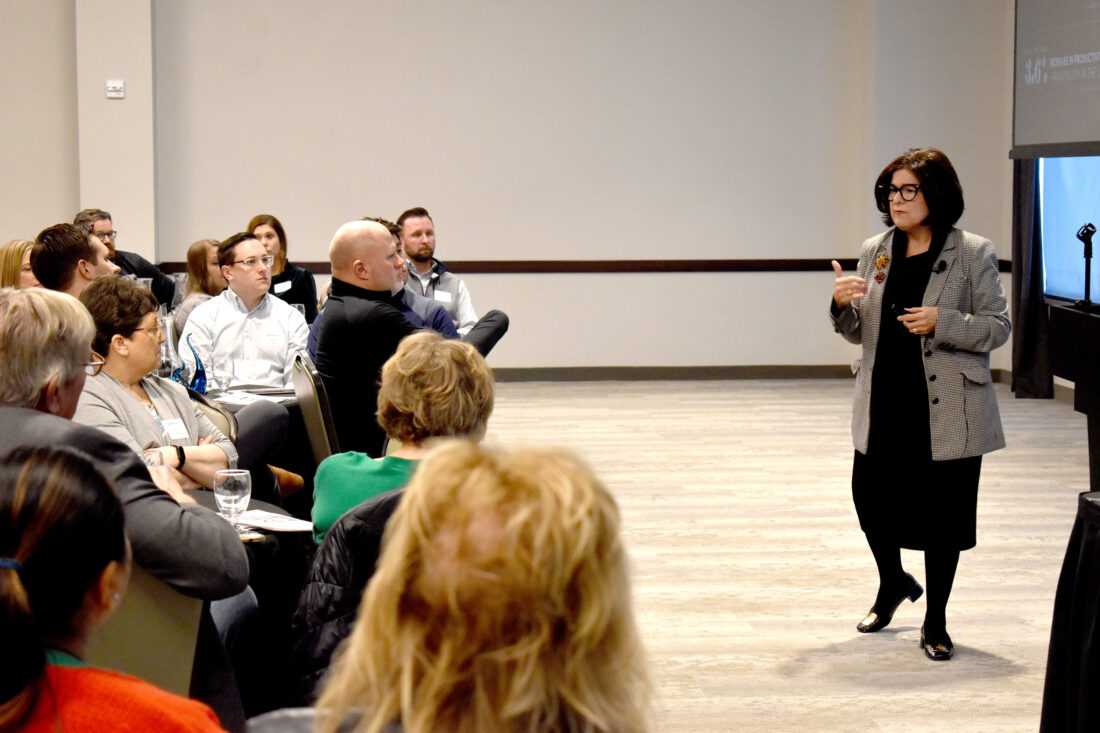
Daily Freeman-Journal photo by Jane Curtis: Debi Durham paces as she talks to the county leadership and officials from surrounding counties during the annual meeting of the Hamilton County Growth Partnership.
When he introduced her on Thursday, Ottie Maxey called Debi Durham “one of our state’s most influential leaders, someone with a vision, and known for her candor and deep understanding of economic development.”
Durham, director of the Iowa Economic Development Authority — IDEA — and Iowa Finance Authority — IFA, was the first keynote speaker to address the newly-formed Hamilton County Growth Partnership — HCGP — a group of local business, education, health care and government leaders formed last year to plan a prosperous future for the Hamilton County, Webster City and its smaller communities.
Durham herself left no room for confusion as to her mission since assuming her position in 2011: “We’re building a climate for business to prosper.”
She proceeded to explain how to the 115 people who had braved the cold and threat of another snow to attend HCG’s first annual meeting at the Briggs Woods Conference Center.
But before she took the floor, Maxey, HCGP’s Executive Director and the event’s host, asked HCGP President Jake Van Diest, to lead off the program. Van Diest thanked everyone “for supporting the county and city in our economic development work. We knew what we’d been doing wasn’t working, but now, with the deep bench of the Ames Regional Economic Alliance, we’re ready to get things done.”
When it was her turn to speak, Durham elaborated on that.
Iowa’s plan for a brighter economic future starts with lower taxes, she said. Beginning in 2018, the state’s maximum individual income tax rate of 8.98% has been steadily reduced, reaching a flat 3.8% rate on January 1, 2025. Taxes on retirement income, and inheritance taxes, have also been eliminated. Corporate taxes, too, are lower.
“We’re at 7.1% today, but want to get to 5%,” Durham said.
Lower taxes, a lower cost of living and a lower cost of doing business have cleared the way for Iowa to compete for industry and jobs nationally. Today, Iowa is number one in low-cost housing, millennial home ownership, manageable commuting, and childcare costs.
“People across America are open to relocation,” Durham said. “Seventy percent of 30-year-olds, and slightly lower numbers of 40-year-olds will move for a better life. These are the young professionals and families we really want to bring to Iowa.”
At 3.8%, Iowa’s unemployment rate is among the nation’s lowest, but, its labor participation rate, at 67.5%, “is a big concern,” Durham said.
“It was 70.3% before Covid, and hasn’t really recovered. One group, men, aged 24-35, still hasn’t come back.” Then she quipped: “Where are they? If they’re in your basement, we want them to get back to work.”
Community development
Durham made it clear that economic development must be accompanied by community development, including better housing, recreation, culture and childcare, among other things. Of paramount concern is housing, she said.
“Housing hasn’t kept up with Iowa’s growth. We need to build new single-family, multi-family, and rental housing. People are staying put due to a lack of alternatives.”
When asked what comes first in Hamilton County, new jobs or housing, Durham didn’t hesitate: “Start now on housing. If you look at Boone, where the new Daisy dairy plant is going in, developers are coming to town now to build homes. When the plant opens, housing will be there.”
Childcare also gets her attention.
During the pandemic, 53% of Iowa childcare sites closed. While the state has spent heavily to improve childcare, many young families struggle, both to find the quality care they want and to afford it. Childcare remains a critical need in Webster City and across Hamilton County.
“We have 200 staff at IDEA,” Durham said. “We provide all funding for advertising Iowa, whether for economic development or tourism. The Main Street Program, disaster relief, arts and culture, even international outreach are all under our umbrella.”
Durham sees international firms as prime targets for her department.
“It’s pretty well understood today that if you sell your product in the U.S. you need to make it here too. We’ve got a huge pipeline of foreign firms looking to expand.”
IFA — the “agency nobody’s heard of.”
Durham described the Iowa Finance Authority as “the state agency nobody knows about.” Its mission is to create opportunities for Iowans, Iowa communities, and Iowa businesses, with no-hassle, low-cost financing.
In 2024, 2,426 Iowans used IFA down payment assistance and loans to become first-time homeowners. To address the aging farm population and overcome barriers to those wishing to start farming, IFA provided loans to 219 beginning farmers, helping them get started in both livestock and row crop farming, including the purchase or lease of 36,025 acres of farmland.
One IFA program, the State Revolving Fund, will be a primary source of financing for Webster City’s rebuilt wastewater and water treatment plants. Sixty-five Iowa cities and towns received low-cost loans for clean water and drinking water projects in fiscal year 2024 totaling more than $270 million.
In relation to the programs at IDEA and IFA, Hamilton County’s and Webster City’s membership in the Ames Economic Alliance, and the related work of the HCGP, have positioned the local community strongly for economic growth.
Durham, ever candid, said, “I like where we are, I like what I see.”
Local News

Webster City High School Band earns 1 rating at Perry Band Olympics

National Honor Society members return to keep organization strong
Electric rates, property taxes head council agenda

Webster City High School Band members earn high marks at Perry Band Olympics

National Honor Society inducts 19 Webster City High School students