
On the trail of Iowa history at Mulberry Center Church
Trending
Summer Saturdays in Webster City are meant to be lived at low speed. In the morning, people all over town are out for a walk with the dog, sipping coffee in a porch swing, or getting ready for a bicycle ride on the Boone River or Brewer Creek Trails they've dreamed about all week. Later in the day, picnics and cookouts pop up and kids head to the swimming pool or East Twin Park.
These are days to savor now and fondly remember next February.
On a select few summer Saturdays, a Webster City tradition of recent years is to attend one of the history or humanities programs at Mulberry Center Church in Wilson Brewer Park. All have an Iowa connection, start at 1 p.m., run for an hour or 90 minutes, and feature experts with entertaining, compelling programs you'd gladly drive an hour to hear. Although technically free of charge, most people make a donation of a few dollars per person to help cover the cost of the speaker's fee, transportation and other expenses.
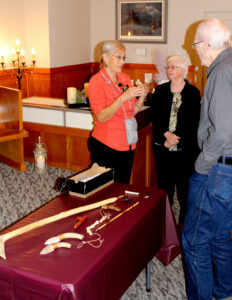
There was widespread agreement among regular attendees that last Saturday's program, presented by Cherie Haury-Artz, an anthropologist and archaeologist working for the Office of the State Archaeologist in Iowa City, was one of the most intriguing programs of the summer.
Haury-Artz took her M.A. in anthropology from the University of Kansas and has focused her research on the Great Plains for more than 40 years.
Her topic, "Iowa's Ancient Trails," is also the name of a project undertaken jointly by the Iowa Department of Transportation and State Office of Archaeology several years ago. The objective was to uncover remaining traces of trails established by Indians, traders, and soldiers before American settlement began, roughly about 1850.
Such trails typically followed routes dictated by local geography: along ridges, around wetlands and across rivers and streams at natural fords. These paths, followed by people and animals for thousands of years, have evolved in more modern times to today's field roads, gravel roads, railroads and paved highways.
One outcome of the project was creation of eight self-guided tours, which can be followed on foot, on a bicycle or in a car, as you prefer. Details of all eight tours can be found on the project's website http://www.uiowacar.com/osaglotrails/ancient-trails-tours-home.
Haury-Artz tailored her talk to her Webster City audience with a brief history of maps of northern Iowa. The earliest dates to 1702, when an unknown French fur trader, seeking to find Indian villages in northern Iowa, sketched a crude map. His travels were exclusively by canoe and on foot. In 1718, a map clearly showing a trail running from Allamakee County in eastern Iowa to Spirit Lake and onward to the Missouri River, was drawn by another French fur trader.
Named the "Chemin des voyageurs," it roughly translates to "the route of travelers."
Maps showed more details of this territory, as the years went on.
In 1719, a map published by Henri Abraham Chatelaine, a map maker and publisher in Paris, shows more tribes and villages, lead mines at Dubuque, and territory across the Missouri River in today's South Dakota.
Jumping to 1837, the oldest-known non-European, non-American map showing the territory of today's northern Iowa was sketched, entirely from memory, by an Ioway tribal member called Chief No Heart of Fear. It demonstrated the tribe's extensive knowledge of a 300,000-square-mile area of northern Iowa, clearly showing the Mississippi, Illinois, Wisconsin, Iowa and Des Moines rivers, and location of more than a dozen Ioway villages.
No Heart and other Ioway leaders traveled to Washington, D.C., in 1837 to ask Congress to mediate a dispute between them and the Santee Sioux, Sauk and Meskwaki (Fox), over rights to land in Iowa, and limit white immigrants from further settlement. Presenting his map, No Heart's moving testimony: "this is the route of my forefathers. It is the lands we have always claimed from old times. We have always owned this land. It is what bears our name," was ultimately rejected in favor of arguments by the more numerous, more powerful Sioux.
Haury-Artz then showed examples of General Land Office maps, compiled beginning in the 1850s, and the GIS (Geographic Information System) and LIDAR maps of today. LIDAR -- Light Detection and Ranging maps -- use a technology only 10 years old to accurately locate historic trails and features in today's landscape.
In one example, LIDAR has uncovered a site in far northwest Iowa called Blood Run, which Haury-Artz calls "a national historic landmark without equal in the State of Iowa."
It was first occupied perhaps 6,000 years ago and contains artifacts from several succeeding Native American cultures. She hypothesizes the settlement reached its greatest size between the years 1500 and 1600, and was abandoned sometime in the 1700s. It is being carefully restored today as Good Earth State Park, by the State of South Dakota, although part of the site lies in Iowa.
Programs of this quality don't just happen. The dedicated volunteer behind the excellent historical and humanities programs at Mulberry Center Church is Carolynn Miller, of Webster City.
Miller was instrumental in saving the church, which she attended as a girl growing up northeast of Webster City in the Mulberry Center neighborhood, and raising funds to steadily improve it since. Today, thanks to her efforts, and the generosity of other donors, it's a comfortable, air-conditioned and heated venue for weddings and the summer lecture series.
For years, Miller has traveled across Iowa, on her own time and at her own expense, to find, experience first-hand, and carefully select programs that would interest a Webster City audience. She has financed this effort entirely on her own and through donations made by attendees and supporters of the lecture series. The first programs were performed in 2011, and have continued each year, with a hiatus during the Covid pandemic.
Three presentations remain in this summer's schedule, including "Iowa and the Presidents" on September 14; "Prisoners of War in Iowa" on October 5; and "Grant Wood, Prairie Rebel" on October 26. The Grant Wood program is a 45-minute, one-act, one-man play performed by Tom Milligan. It promises a unique insight into the work of one of Iowa's best-known artists.