
The Historic Jane Young home was Webster City’s first library
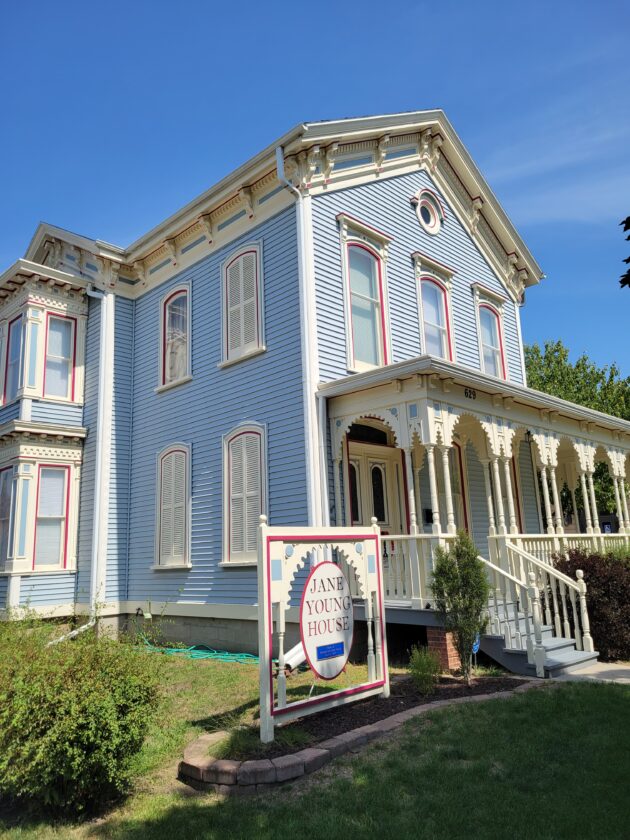
Painters meticulously gave a recent facelift to the exterior trim on the Jane Young House. Their task included adding new coats of colonial blue, raspberry and cream paint to 41 windows, including five “mystery” windows. Note the four windows on the west side of the home. Only one is a real window. The others add architectural symmetry but are covered with slats. The east side also has a “mystery” window. Check it out when you come to the Ice Cream Social on September 17.
Editor’s note: Folks, this is the third of a four-part series leading up to the September 17 celebration of both the Jane Young House and the Webster City Women’s Club, which meets at and maintains that historic former residence in Webster City.
By LOWEEN GETTER
With the original business district just a block east on Seneca Street, Willson Avenue became the ideal location for the well-to-do businessmen of Webster City to build their fine homes in the latter decades of the 1800s.
It was there that Kendall Young, the richest man in town, designed a Victorian-era home for his wife Jane. His nephew T.D. Young came from Maine to build it. The ground was broken in May 1874 and the home completed a year later.
The site, a former hog lot, was purchased from Jane’s brother Dan Underdown, proprietor of the nearby Willson House. The site was large enough for the home, a barn, woodshed, trees, shrubs, and bountiful gardens, all enclosed by an ornate iron fence.
The Youngs moved into a simple dwelling in “Yankee Town” when they arrived in Webster City (population 400) in 1859. They lived there for 16 years before moving to Willson Avenue. Jane spent only 13 years in the beautiful home that now bears her name before health issues related to Bright’s Disease led to her admittance to Battle Creek Sanitarium in Michigan. She spent her last 15 years there, never to return to her beautiful home until her funeral in 1903.
Kendall lived in their home until he joined Jane at the sanitarium six months before he passed away in 1896. His body was also returned to Webster City for the funeral in the parlor of his home.
His will gave his entire estate to the city to build a public library.
It was determined that the Kendall Young Library should be built where the house stood. But until Mrs. Young passed, the house served as Webster City’s first library from 1898 to 1904.
Then the house had to be moved to make way for the new library.
There were no bidders for the property, so the library board had it moved to the southwest corner of the lot and turned to face Elm Street. Mr. C.H. Roberts of Rolfe, Iowa, was trusted with the task. It took just five days in April 1904 to set it on its new foundation. There is no knowledge of how that was done with only horsepower.
The house was rented for $25 per month to the Harvey Pettibone family for about 20 years. He was a traveling salesman for Carson, Pierre, Scott Co. in Chicago; Mrs. Pettibone was a member of the 6 O’Clock Club and the Home Club.
According to an earlier account in this series, Mrs. Zitterell, wife of the man who built the Kendall Young Library, was responsible for organizing the Webster City Women’s Club for the civic and educational betterment of the ladies of the town.
As a member of the library board, it was she who turned over the keys to the club in November 1923. The Webster City Women’s Club meetings and social events have been held at the Jane Young House for 100 years in exchange for its care.
Library Expansion forces second move of Jane Young House
It was the efforts of the Women’s Club and the Jane Young House Foundation that raised more than $45,000 to save the house in 1997. The house had to be moved 58 feet to the west to make way for the People’s Project expansion of the Kendall Young Library. The house would have been demolished had the community not supported the project.
That March, the 120-ton house was moved the second time by the Holland Moving Company of Forest City. The company poked holes in the foundation with a hydraulic jack, built six wooden cribs in the basement and rolled in iron beams. Then cross beams were placed under the home, and it was lifted. Cribs were built in the new basement awaiting its new occupant by the week’s end. It was back-filled and the furnace installed.
But that wasn’t the end of the enormous task. More money was required to replace sidewalks, build a stairway to the basement, add air conditioning, rebuild the front entry, and add a handicap accessible ramp. Further renovations would include a wrap-around porch, a wrought iron fence, and a wider parking area.
In 2000, hail forced the replacement of the roof and siding. One hundred and twenty-six years of paint was removed from living room and dining room woodwork, repairs were made to windows and lacy curtains added. New carpet was installed on the main floor and stairway and the bathroom received new wallpaper.
A fresh look for the second floor would occur later.
Recent upgrades to the house include newly painted exterior trim, a new roof, and fresh landscaping. Nancy Tjaden, Chad Eells and crew were up for the intricate task of removing, cleaning and replacing Plexiglass window covering, scraping and painting the front door, porches, ramp, corbels, dentil trim, gingerbread, and windows with the colonial blue, raspberry and cream color palette. That meant 41 windows, 260 poles and balusters, and a power lift to reach the highest gables.
These latest improvements were made possible through generous gifts from Adele Bowden and the Maxine Packard estate.
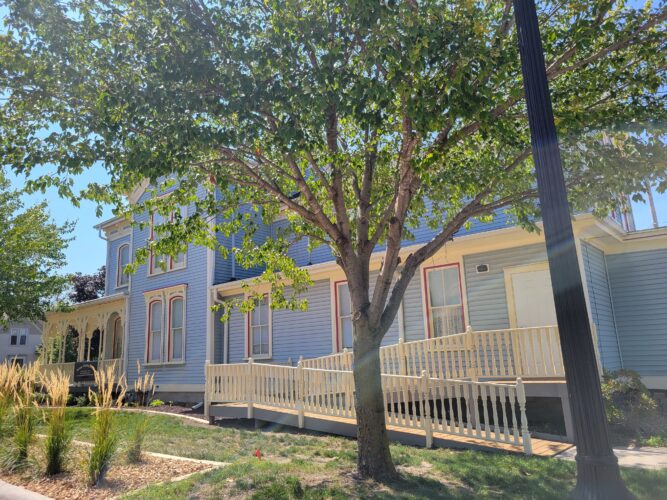
Recent improvements to the Jane Young House include exterior trim paint, shingling, and landscaping. Each of the 260 balusters and poles were hand-painted. Shrubs and grasses were added to the east side.
Local News
Celebrating completion of the shelter
Blairsburg expands park shelter; dedicates new facility Sunday

Another abandoned home demolished
Public meeting will be held at 10 a.m. today in response to petition to State Appeal Board
A public meeting will be held at 10 a.m. today in the Hamilton County Courthouse in response to the filing of a ...
Supervisor meeting today includes Briggs Woods Conference Center
The agenda for the County Supervisors meeting today includes many of the typical topics. But one item stands out, ...
Legacy Learning-Boone River Valley offers Wet Felting Workshop next weekend
The Legacy Learning — Boone River Valley will offer a workshop on Wet Felting on a Ball on June 20. This ...