Van Diest, Guth and King oppose a carbon dioxide pipeline in Hamilton County
Where to stand?

Jake Ketzner, vice president, Government Relations for Summit Carbon Solutions, was the company's chief spokesman during the public hearing held Thursday August 29. Later that day the Iowa Public Utilities Board granted the permit sought by the company, clearing the way for it to begin negotiating with farmers for easements in the proposed right-of-way.
Part 1: To educate readers about this complex, technical issue, today we begin a two-part series examining both sides of the matter. The decisions made on this issue will shape Iowa’s agriculture and environment for generations. In this first part, we will consider the arguments in favor of carbon capture pipelines.
On Wednesday, we’ll look at potential negatives.
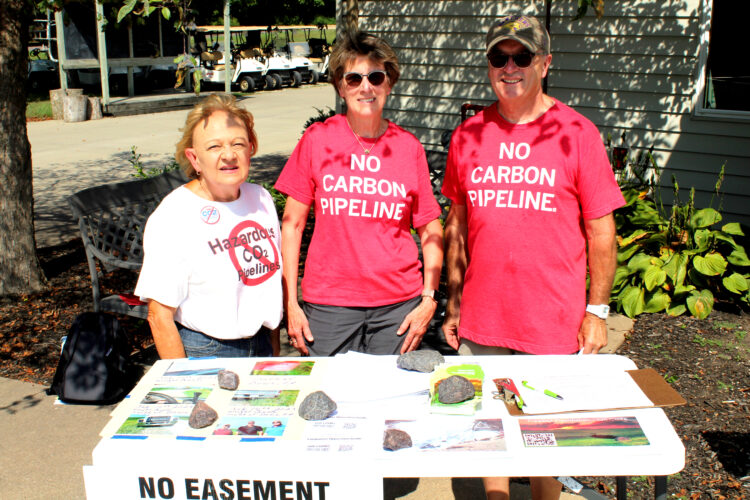
Marj Swan and Julie and Paul Glade, all Wright County farmers, were at the Iowa Utilities Commission public hearing in Jewell Thursday, August 29, to propose construction of a proposed CO2 pipeline by Summit Carbon Solutions.
Carbon dioxide pipelines in Hamilton County are a step closer to reality.
After a public meeting in Jewell on August 29, the Iowa Public Utilities Commission issued a permit to Summit Carbon Solutions for a new 12.8-mile pipeline across southeast Hamilton County.
Apart from ethanol industry executives who spoke in favor of the pipeline, virtually all of the 100 attendees were there to oppose it.
Among those against the pipeline are some well-known names: former U.S. Congressman Steve King, state Sen. Dennis Guth, R-Klemme, and Bob Van Diest, Webster City businessman.
The company behind the pipeline is Summit Carbon Solutions — SCS — headquartered in Ames. SCS is a subsidiary of Summit Agricultural Group, based in Alden. Summit Agricultural manages farm land for itself and clients, and operates a private equity division, matching investors with agricultural investment opportunities. Summit’s founder and chairman is Bruce Rastetter, who was president of the Iowa Board of Regents from 2013 to 2017.
Former U.S. Ambassador to China Terry Branstad is senior policy advisor to the company.
Jake Ketzner, vice president, Governmental Relations for SCS, was the company’s chief spokesman in Jewell. He explained the need for the pipeline as SCS sees it.
“We’ll capture CO2 emissions from 57 ethanol plants in five states (North Dakota, South Dakota, Minnesota, Nebraska and Iowa), dehydrate and compress it, and move it to central North Dakota, where it will be safely stored in rock formations a mile underground.”
He continued, “Ethanol kept corn profitable for farmers until we over-produced. Today, at $3.85 a bushel, farmers lose money on corn. With this pipeline, we can reach new markets, and give young people a future in farming.”
The new market he’s talking about is sustainable aviation fuel — SAF, which Ketzner claims is six times bigger than today’s ethanol market.
In 2021, the International Air Transport Association, a trade group of 330 airlines in 130 countries, pledged to emit net zero emissions by 2050. Jet aircraft, which fly on kerosene today, are by far the dirtiest, least efficient means of transport on Earth. Contrails, those clouds visible behind a plane, contribute to pollution and climate change. The jet plane is the poster child of pollution, global warming and climate change, and its use grows every year.
SAF isn’t a pie-in-the-sky brainstorm. A plant in Soperton, Georgia, opened in January 2024, will soon become the first in the world to produce it. The feedstock will come from Brazil, not the U.S. Midwest.
Why?
U.S. ethanol isn’t clean enough to reach the carbon target set for the fuel.
Ketzner said, “The only way Midwest farmers can access the market for SAS is with carbon capture and sequestration.”
It’s unknown whether sustainable aviation fuel actually can, or will, replace kerosene in today’s airliners, but SCS is putting billions of dollars into this pipeline to make Midwest-made corn ethanol a viable competitor for that business.
Ken Smith, CEO, Innovative Ag Services, which runs an ethanol plant near Pine Lake, sees the pipeline as vital to his company’s future.
“Ethanol demand is the same thing as corn demand. Corn production is stagnant. Corn yields keep going up; less of it’s used in animal feed, and South America is increasing production. If the pipeline is built, we’ll expand our plant and hire at least 10 new employees. It will further secure the jobs of the 40 who work there today.”
If built, the Hamilton County pipeline will be made of carbon steel, 6 inches in diameter, and buried at least 4 feet underground. The right of way requires a 50-foot-wide easement with another 50-foot easement to be used only during construction.
SCS claims topsoil will be reserved and reapplied, and that it will “de-compact” heavily-compressed soil after construction.
Before the pipeline goes into service, it will be tested at 125% of normal, operational pressure rating. If the required permits and land can be acquired, SCS says the pipeline could be running by 2026.
Many people at the Jewell meeting asked if SCS could be trusted to manage the project. It’s a new company that’s never built a mile of pipeline.
Ketzner cited 5,300 miles of CO2 pipelines run by other companies in the U.S. as “the safest of all pipelines.” He told the Jewell audience carbon capture “has been around since the 1970s” and cited installations in North Dakota and Illinois.
One of those, The Archer Daniels Midland ethanol plant in Decatur, Illinois, is the first large industry in the nation to permanently sequester CO2 underground. Beginning in 2011, the plant has been the site of a demonstration project involving ADM, Schlumberger (an oilfield services firm), Richland Community College, Decatur, and the Illinois State Geological Survey. The U.S. Department of Energy gave the project $281 million with the objective to demonstrate whether or not on-site carbon capture and sequestration was feasible.
An April 2024 article in “Oil and Gas Watch News” found the ADM plant “captured only 10-12% of the plant’s emissions each year, at most, allowing the rest of the carbon dioxide to escape into the atmosphere. This raises questions about whether industrial scale carbon capture technology can be a meaningful solution to global warming.”
The article went on to say that even given the low amount of carbon capture, “the ADM facility in Illinois has fared better than most other carbon capture projects around the world. Though the technology has been around since the 1970s, most projects have failed.”
While the carbon capture industry is new, and its technology still in development, Sally Benson, former director of the Global Climate and Energy Project, and professor of Engineering at Stanford University, puts the situation in perspective: “Every bit of CO2 we put into the atmosphere leads to more warming, and we’re running out of time. This is a technology at hand that gives us yet another tool, in addition to renewables, to begin to reduce our emissions.”
On Wednesday: 80% of Iowans oppose CO2 pipelines. Should that matter?
Local News
Ace is the place and it is open for business
Career Ag Academy celebrates official grand opening Thursday
JunqueFest is here
A full day of music, shopping, and community fun is planned as JunqueFest returns to downtown Webster City from ...

Torch run held by Hamilton County Peace Officers

Wildcat Distillery making progress with making The Elks their dream location